We met in 1996 at an advertising agency in Austin, Texas, and became fast friends. He was a freelance graphic designer, there trying to make ends meet. At the time, he wasn’t the well-known food writer, photographer, or digital media social connector whom so many now know. He invited me into his social world in Austin – a mix of artists and musicians, designers and tech folks, academics, and restaurant people – during a time in which we were both depressed and somewhat adrift.
Paul introduced me to some people he knew at a digital studio named Human Code, a company then doing what few in the world were doing – interactive CD-ROMs – and I eventually took a job as a lead designer and project manager. During those days, around 1997, Pableaux was already gathering friends every Monday night at his shared rental house for red beans and rice, the traditional meal that hired help from New Orleans would cook on laundry days to feed themselves. At Pableaux’s place, this was a standing invitation: just show up, bring something to drink, sit down, eat and converse in the company of existing or new friends, stay as long as you like, and roll into the new week fed and socially sated. I met friends in those days who are still in my life. And of course, Pableaux did that every week, without fail, for 30+ years.
An aside – a funny Pableaux-ism – he had what we jokingly called “grackle brain,” after the noisy blackbirds omnipresent in Austin, an annoying tendency to become distracted by shiny objects, people, ideas, TV shows, etc. As a result, Paul was perpetually caught between multiple unfinished projects, each of them immersed in a kind of creative chaos that made sense only to him. It was around that time that he got the brilliant idea to put each of his in-progress design and writing projects onto an individual metal baking tray to preserve the organized chaos that worked for his grackle brain, and then he’d slide the tray into a slot of an upright commercial bun and sheet pan cabinet, one project per tray, and close the door. Chaos preserved, yet hidden from view during social engagements.
In those days, Pableaux also started hosting Sunday afternoon gumbo parties in December, during the blissfully cooler winter months of central Texas. He’d gather post-Thanksgiving turkey carcasses he’d stashed in the freezers of friends all around the metro Austin area, and cook them down into *huge* vats of turkey stock. These he’d use as the base of the most epically-famous cauldrons of turkey gumbo known to the human race. We’re talking *liters* of dark roux that would thicken many commercial-sized vats of the most perfectly-spiced gumbo, red beans, and rice. I think for one such party, we estimated he cooked up over 30 gallons of gumbo. And then, in what he became famous for, he’d invite 100+ people to come by on a casual Sunday afternoon, and he’d feed us until we were full. Parties were always on Sunday afternoons because, as Pableaux reasoned, people had to go to work and school on Monday mornings, and they were less apt to overstay their welcome, and the event would naturally wind down by early evening. Typical Pableaux social brilliance.
Also around that time, the SXSW film and media festival added an interactive media track to its already well-attended proceedings, and by 1998 and 1999, people in the world of interactive media – including the early Web – were arriving in Austin from all over the world. In those days, the communities of people working in interactive media in the US were fairly regional and distinct, and two of the epicenters at that time were Northern California – specifically San Francisco and Silicon Valley – and Austin, Texas. We in Austin were aware of what was going on in California at businesses like Wired/Hotwired, but the communities of people weren’t intimately connected in real life. I had friends during that time who participated in a much-loved email list, many of whom were poets, designers, and writers. Many of those people were also involved in the early Web, and some of them in later years went on to make some of the most well-known products and companies of the time.
By 1998, I was becoming really dissatisfied with the tone and vibe that started to permeate SXSW when money people started foaming at the mouth, looking for investment opportunities. Pableaux and I missed the quirky, weird, creative environment for which early SXSW was known. I wanted to know the people, and I wanted them to know the real, weird Austin, not some polished “new media” version of it. The problem was, I was a social introvert and I wanted to find a way to make meaningful connections. So, I developed an idea that I proposed to Pableaux: I had friends who were themselves connected to an eclectic collection of creative and smart people, many of whom were going to be meeting each other face-to-face for the first time at that year’s festival. What if we found someone in town with enough space to host a party? I’d spread the word through the community of people I knew, I offered to help Pableaux cook up his famous turkey gumbo, and he’d do what he was already so good at doing – feeding and entertaining people.
Pableaux didn’t hesitate; he was all in. Turkey carcasses came out of freezers and were cooked down. A date was set, a house was secured with my friend and colleague, Heather Anne, and invitations were delivered by email. And then, before we knew it, the situation got out of control. We thought maybe 20 or 30 people might attend, but 150-175 people (maybe more; I can’t remember) arrived from every corner of the U.S., many of whom were from San Francisco. Pableaux, of course, was in his element: my dear grackle-brained social butterfly, sometimes depressed friend, smiling, laughing, hugging, feeding strangers who would become his dear friends for the rest of his blessed life.
That party connected the Austin and Bay Area design and tech communities and introduced many people to each other for the first time – many of whom are still friends and who now mourn the loss of our dear Pableaux. And that party most certainly also changed the direction of my life.
Pableaux eventually migrated back to his beloved Louisiana and New Orleans. He went on to live in a one-room church in St. Martinville – the altar becoming his kitchen, of course – and his food writing career finally took off. His various books, Saveur, The New York Times, Bon Appétit, Southern Living, and eventually a nomination for a James Beard Award and a Le Cordon Bleu World Media award.
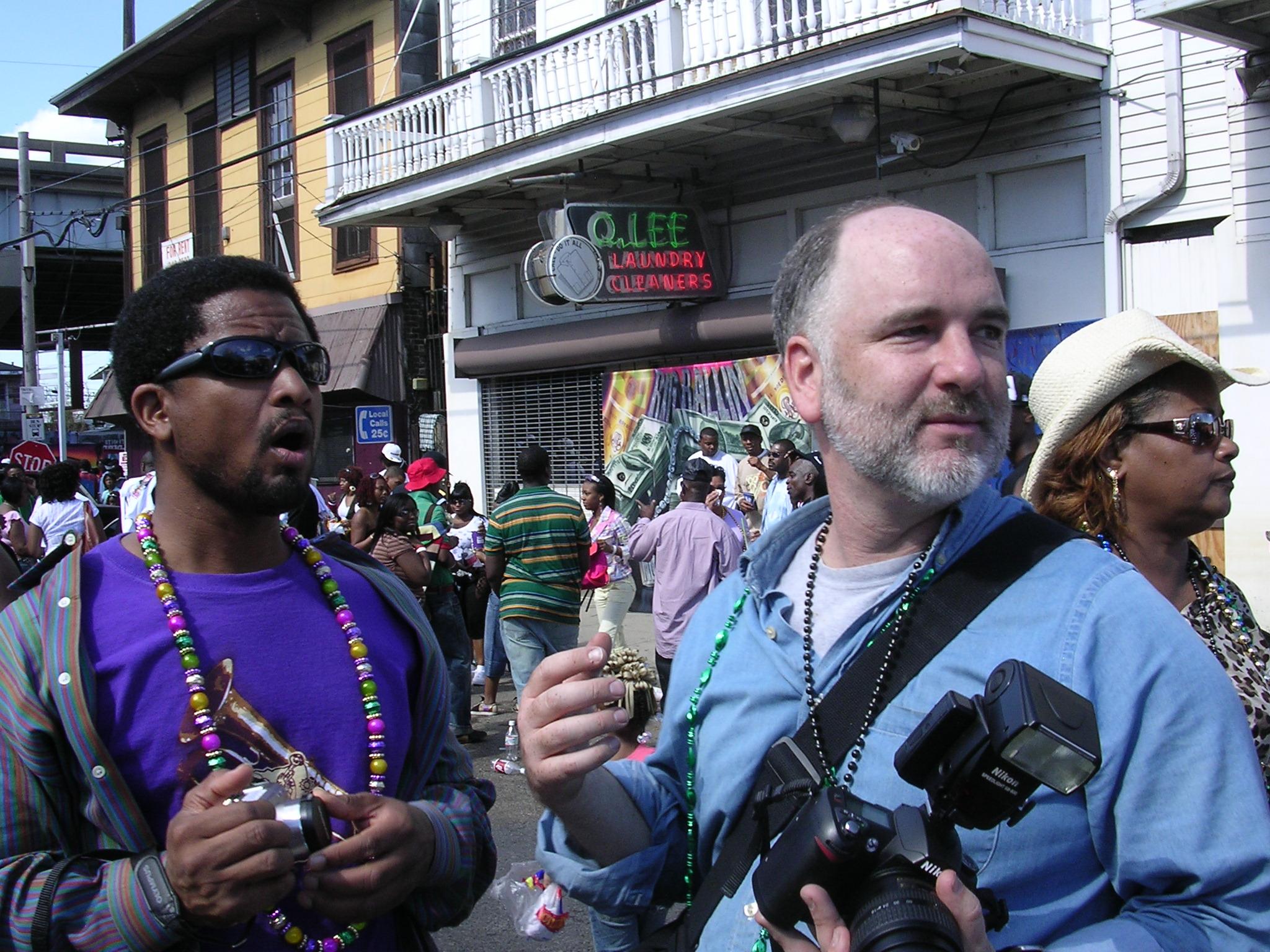
We also shared a love for photography, and around 2007 I gifted him a 70-200mm f/2.8 Nikon lens that became his favorite portrait lens. I see that lens at his hip in the last photos of him taken. It brings me so much joy because of what he did with that lens: putting it to good use to connect the communities of people around him, documenting the regular Second Line festivities and the various annual Mardi Gras Indians tribes and krewes. And, without fail – because it was impossible not to – they came to love him, and he them.
This was Pableaux’s way – connecting diverse communities of people to each other through his warmth, love of food, New Orleans and southern culture, art, writing, and humor. I've never known anyone in my life to be more utterly authentic and exactly himself with everyone he met. Like many others, I considered him one of my dearest friends, and I have been and will be forever blessed that he was in my life. He was rare, and he’ll be celebrated by many.
A few other things I’m going to miss:
- His incessant shit talking, and the constant annoying distractions, non sequiturs, and tangents. One time, Paul told me his problem was that his brain was hardwired to his mouth, and he had no control over it.
- The calls out of the blue, Pableaux mid-sentence in his car, train blaring in the background, or his attention split by one of 47 other background distractions: “Hey, boyo! Tellmewhatchabeendoin’! Tellme, tellme, tellme!”
- His joy and childlike curiosity – the near mania, driving himself non-stop until he crashed hard.