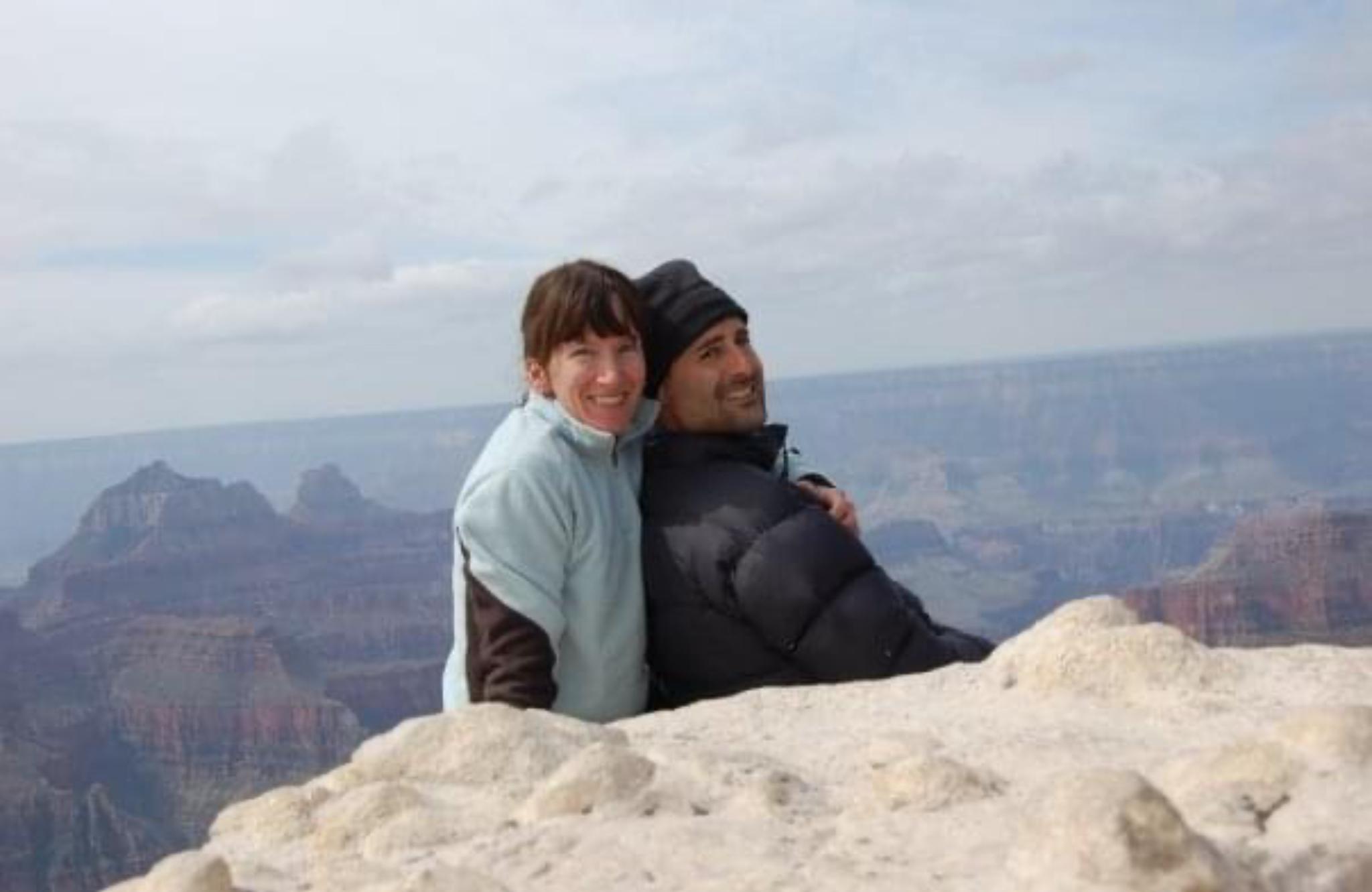
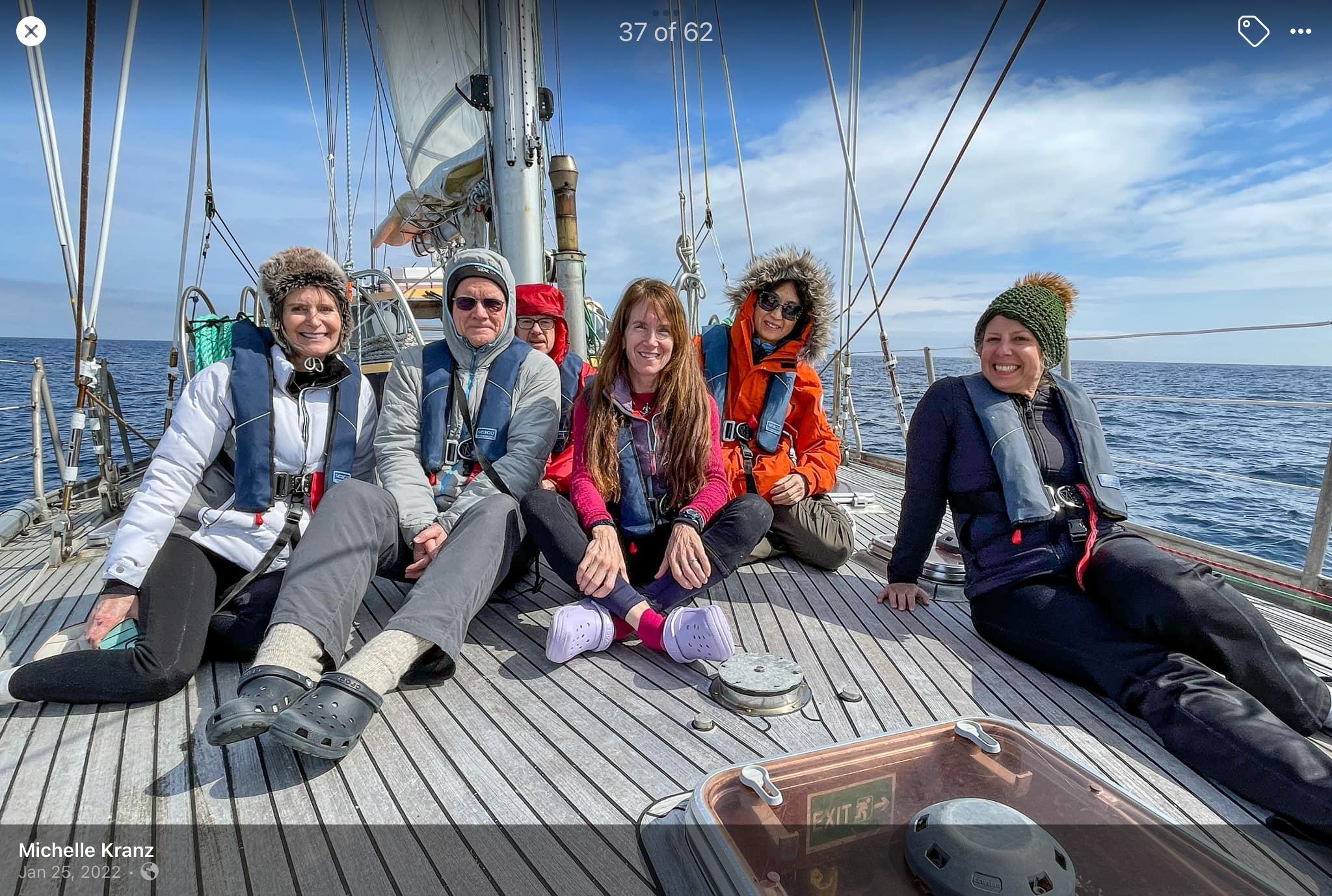
A leader of one of Michelle's international wilderness photography trips asked the attendees to tell the story of their most epic adventure in life to that point. Michelle told of our (unintentionally) adventurous climb of The Prow in Yosemite. She said the attendees clearly thought hers was the exceptional story. In memoriam, here is my version. I caution that not everyone may want to read this, as it might be an emotional read given it deals with climbing dangers. It was certainly emotional for me to write it, and it kept me up for nights as I thought about it. But it was a huge event for Michelle and for me, and I feel it should be recorded somewhere for her honor and her memory, as we both treasured the event, our survival, and the memories. There is nobody I would rather have faced this ordeal with, than her. Here is the abbreviated version, sparing you a lot of arcane climbing details.
----
Dusk was approaching. We lay in the dirt, sprawled out with our heads resting on the ropes. It was almost November, we were at nearly 8000 feet elevation, and we were completely exposed to the elements of Yosemite high country. Yet getting cold was not a concern. We were hot and exhausted, and looking forward to a cold night.
I stuck my finger in my mouth and felt the sponge cake texture on my gums, cheeks, and tongue. I scrapped a big wad of decaying tissue from the roof of my mouth, pulled it out and examined the grey and black dead tissue. I already knew what my lips looked like, because I had seen Michelle's.
"Michelle," I said as I gazed into the darkening sky. "If I can't get up tomorrow, you have my permission to leave me here and go get help. I won't be going anywhere."
"OK" she replied.
I had complete confidence she'd do what she could. Women ordinarily do better in these life and death situations, and I knew Michelle was not even close to being an ordinary woman. If anyone could get out of this situation, it was her. Her mental toughness was likely beyond anyone's whom I knew, and it was certain she would be going until her muscles stopped.
The Prow is an infamous big wall route in Yosemite. Sheer, blank, and vertical, it is such a stunning line that it even compelled the greatest "Clean Climbing" Guardian, Royal Robbins, to install 38 bolts up hundreds of feet of blank wall just to aid up it. Hundreds more feet of incipient seams extend either side of that; thin lines that don't accept modern protection or even pitons, but only take tiny swages of soft metal mashed into minute "inconformities". Hundreds of feet of this glued-on bubble gum, must be fully body-weighted to ascend this route.
The route is considered a moderate big wall route by most. Some even suggest it is a beginner big wall; but because several hundred feet of this route has no usable cracks, your experience depends greatly on the gear fixed in place. For on a route like this, few would carry a bolt kit, or pins and copper heads with a hammer (for smashing into the minute crevices) to get past a blown out section.
As it happened for us, a lot of the gear was not in good shape. It was so poor on several pitches, that it was clear Michelle had to lead. The difference in our body weights would probably make the difference between some manky metal swages and tattered slings staying in place, or me blowing it out once weighted, falling feet first over head. Thus leaving us with an even longer blank section to get past.
A lot of factors led to slowing our ascent. First, the route (at that point at least) is simply harder than the grade suggests, and compared to other routes around the same level, this is a significant step up and many feel it should be graded harder (e.g., C3 not C2). Michelle had to lead all the hardest pitches due to those factors, and that is tiring. It was my first wall, and undoubtedly I was not as efficient as I could have been. The calendar was just about to turn to November, and the days were very short and we didn't properly plan for that. Then the real stinger, there was a sudden, not-forecast afternoon storm that left us stuck in the middle of the blankness for a night, adding many hours to our logistics.
And finally it was hot, and as our water supplies dwindled in the heat and our delays, our strength and energy dropped precipitously. Eventually it became impossible to eat, due to our dehydration. And what should have taken hours, was taking an entire day.
We summitted near the end of the fourth day on the route, after just under three "days" of actual climbing (first day was a midday start, and the storm stopped us on day 3). We should have finished in around 48 total hours, and that's the provisions we brought. So now we'd had no water for at least 36 hours, all while doing very strenuous work in the direct sun. Water is very heavy; but we were paying the price for not bringing enough.
At the top, we quickly looked around for any standing water, but there was none. Dry as a bone. The previous day's storm had been a lot of wind and threatening electricity, but no collectable rain. Time to hit the road, and fast. The descent from here is notorious; guidebooks actually recommend hiking up the descent before doing your intended climbing route, just to familiarize yourself with its complications. The books don't even say for El Cap. But that would've taken a full day and precious energy, and as fly-in climbers on a schedule, we did not do any reconnaissance. Now standing on top, we knew we had a long, tricky, and uncertain descent ahead of us, there was a mere hour of daylight left, and given our physical and mental state, navigating the downclimb by headlamp would be deadly. We knew we'd be spending the night somewhere in the open.
We left thousands of dollars of gear on top, in a big mess. There was no way we would get down alive with that load. We didn't have the strength to lift it up anyway. Our lives were on the line, and getting an emergency rescue from here in 2006 was a long shot. We grabbed enough gear to hopefully get down; a couple ropes and cams, nuts, and carabiners. Neither of us expected to make it to the standard descent, either tonight or tomorrow. Getting close to it, and praying for another climber team to happen by, was the best hope. But in November, there are not many climbers at this end of the Valley. The situation was dire.
We scrambled down from the pinnacle where our climb had ended, and our hearts sank further. Trails scattered like cobwebs in all directions. Some going up, some down, left and right, all over the place. We briefly considered heading left, to get near the top of a beginner's trad climb probably two miles away. But we wouldn't necessarily recognize the top out, as neither of us had done it. Besides nobody would be summitting that route for another 20 hours, at least. That would be too late. So we started to our right aiming for the standard descent. We hadn't walked more than 30 minutes when darkness and exhaustion overtook us. It was pointless and dangerous to continue. So we found a flat spot to lie down. In the cool dirt. And that part, at least, felt fine.
The next morning, we actually awoke before dawn to very nice cold temps, feeling not terrible considering it was now over 48 hours without water. That's the weird thing about dying by dehydration, I realized. If you're not having to exert force, if you're not in hot temperatures or in the sun, you aren't actually suffering too much. Your body and mind are just shutting down, and if not disturbed, you might just sit there peacefully for the remaining hours of your life and pass out into oblivion.
We got up and started to walk, and it was OK - as long as it's down hill. We walked maybe 20 minutes on flat or downhill trail. Daylight was breaking, and we saw the sun rising across the valley, near Half Dome, with dread. The descent trail ahead, actually ascended now, for a hundred feet of elevation, maybe a bit more. I told Michele that I could not get up that hill, especially with sunlight starting to hit it, and survive any longer. Michelle agreed.
Our only hope for a self rescue - and probably any rescue at all - was to start getting down the 1000 foot plus vertical face to our right, down to the valley floor, as far as we could get. Ahead, a small dry creek groove creased the trail - no doubt formed due to runoff from the hill ahead (that we were unable to ascend). The dry creek continued into a bushy area near the cliff edge. Perhaps there was sufficient shrubbery to tie off a mess, rappel a ways down the cliff to an exposed stance, and yell with our remaining strength down to the valley below and with God's Grace, attract the attention of some hikers down there somewhere.
We got to the edge. Not only were there enough stout bushes to tie off to risk this maneuver, but someone had done it before! This was a huge discovery. Quite possibly, this anchor of dried and dead bush would hold us, it held others before us. And did we have any choice? Using the in situ slings would also allow us to save some of our slings for another rappel further down the cliff. Our luck improved with a leaning peak over the cliff edge; this rappel would reach a gully below us, with more bushes at its edge, meaning another rappel, with another existing mess of slings, could be possible. Every rappel down greatly increased our chances of getting attention from a stray hiker below.
One rappel led to another rappel. We were leaving some gear and slings, but could utilize a lot of gear left previously. It had been many years it seemed since anyone had been so desperate as to take this path. We progressed down the cliff with increasing optimism that we would be able to summon help. And beyond the progress, we had our biggest break yet from Mother Nature. Across the valley, the sun was getting higher and higher in the sky. We should've been receiving our final turn in the rotisserie oven and end up two parched bodies in hanging in space; but we were protected by the blessed shadow of Half Dome, blocking the death rays from striking us as we descended this barren old water drop. All around us, the sun was striking the wall and heating up the world. But we were cushioned, for now.
With about 3 or 400 feet to go, the shade of Half Dome finally relinquished and we were exposed to the direct sun. But we were now past the point of yelling out for a cliff side rescue, we were going to get down to the valley on our own damnit. Michelle went down first at this point and out of my sight. I just pulled on the ropes for tension to figure out when it was my turn to descend; nobody had any strength to yell out communications. When I got on rap, to the edge and looked down, I saw her laying face down on a small ledge. Michelle! I cried out, fearing she had finally succumbed to heat. As I got closer I could hear her say, it's OK, I'm just trying to absorb the cold from this shade. Whew. This was the final lucky break we needed - a final boulder on that ledge, a "mini Half Dome", now gave us a small sliver of shade to prep for our final rap.
I sheltered in the small patch of shade for ten minutes or more, before gathering the strength to get up in the sun to pull the rope. Every 30 seconds in the sun now required a minimum 20:1 shady rest time in order to lower the body temp enough to prevent cramps, seizure, death. Another 15 minutes of shady rest, and I ventured into the sun again to set up our final rappel anchor. It used the last of our gear. Two tricams. Ironically, in normal times, we could have easily scrambled down the slope below us. But no way, not now.
Michelle stayed sprawled out on the ledge this whole time, just as it should be. Our strategy was for Michelle to rest, and given she had the most strength, her task was to rappel first and run downhill into the trees, and start looking for a tourist trail to find help before becoming overcome. It was now full daytime, hot, and we'd had no water for around 55 hours. We were truly at our last gasp. I would do the rappel once and if, I felt I could make it to trees. It didn't matter, either Michelle would reach help or she wouldn't.
Michelle rapped down. Some 20 minutes later I felt ready to move. Once down I left the rope hanging there and ran for the trees where I sat again in shade. Before long I heard the loveliest sound I maybe have ever heard in my life: "Chris! Chris! I have water!" sang out Michelle. I just about cried - except of course, if there are no tears, are you really crying. We were down out and safe. Maybe with impaired organs... but our bodies were down and whole.
Michelle had found two hikers, which was a very fortunate thing at this end of the Valley, this time of year. They gave her spare water, and they all came to find me. I took several big gulps - and instantly an astonishing thing happened. All over my body, from my scalp down to my toes - little beads of water, sweat, popped out on my skin. Little bubbles of life-saving evaporative cooling erupting all over my body. I was amazed. Our bodies had held on to our remaining free water as long as possible, dancing a tight rope of death between heat stroke, and maintaining passable body chemistry and functioning organs.
With profuse thanks, we walked our way back to the main trail system, the shuttle bus, and more water. By evening, we felt pretty normal. So much so that I had the hubris to start thinking that tomorrow I could go up and get our gear, with help. Michelle wisely counseled me no, saying we are depleted and it will take a week to recover from this, you are weaker than you think. Wisdom from the Pikes Peak Marathon I think.
We did find two relatively trustworthy climbers to go fetch our gear, and that search for talent is another story in itself. These two worked for the Yosemite rescue team, and were fit and in their 20s. We had just over a day left before catching a flight out, and so it had to be them, or just leave our gear, and that of many friends, up there and suffer the consequences later. But 10000$ was a worthwhile price to have our lives back.
Even these two young climbers knew this would be a big job, ascending the standard descent, packing the gear, and descending it again. They hiked up immediately late in the day, and spent the night near our gear. They hoofed it back down the next day, arriving hours before Michelle and I had to leave for the airport. They looked exhausted. Michelle was right, there was no way I was fit for that job.
For these past 17 years, it has been on my list to return to that descent, find our path down that 1000 foot cliff that saved us to later in life, and see if those tricams were somehow miraculously still fixed in that crack 80 feet up, and bring them back to show Michelle. Or, find out if some other poor team had found them on their own perilous survival descent and simply removed them and downclimb the simple slab we were incapable of getting down. Michelle was amazing during this ordeal. No complaining, no self-pity, no blame - just working together to get our bodies down to where they could be saved.







 Share with others
 Donate in memory
