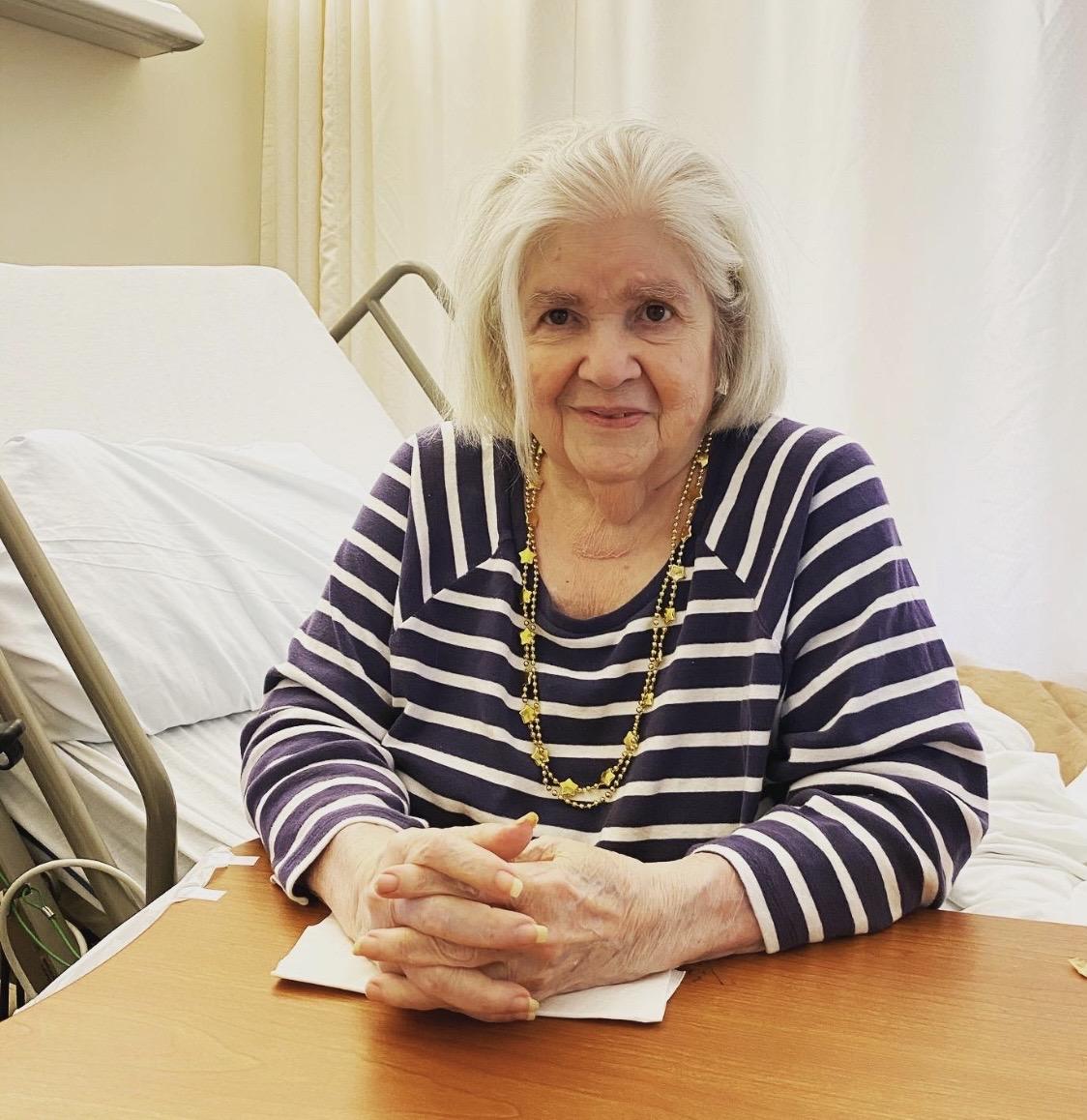
I’ve been troubled that we haven’t added more to Mom’s timeline. It seems inconsequential to list her jobs, her schools, or the birth of myself and my sisters. She lived through the depression, World War II, the Vietnam war, the assassination of JFK, Martin Luther King and Bobby Kennedy, Neil Armstrong’s walk on the moon, 9/11, the Iraq/Afganistan wars, the insurrection at the US Capitol and the global pandemic. I know witnessing these events informed her life but they don’t define it. I continue to think of that song from “Rent” (Seasons of Love) which asks “how do you measure a life?”
I don’t want to leave it that there’s nothing here signifying my mom‘s life and the loss of that life.
I am reminded of the Adrienne Rich poem, “Transcendental Etude”,
“And we’re not performers, like Liszt, competing
against the world for speed and brilliance
(the 79-year-old pianist said, when I asked her
What makes a virtuoso?—Competitiveness.)
The longer I live the more I mistrust
theatricality, the false glamour cast
by performance, the more I know its poverty beside
the truths we are salvaging from
the splitting-open of our lives
The woman who sits watching, listening,
eyes moving in the darkness
is rehearsing in her body, hearing-out in her blood
a score touched off in her perhaps
by some words, a few chords, from the stage,
a tale only she can tell.”
Listing life events won’t tell the story. Mom’s life was often a struggle. My grandmother was not warm and often not kind. My father was unable to function most of his life due to addiction. My mom was a single parent for the majority of our lives. There was poverty, violence. There were times when she had two jobs just to put food on the table. Those were hard times in the late 60s and 70s. She did not have it easy. Struggle was woven throughout her life just to meet our basic needs. All of these kinds of events challenge and change us but from my perspective, the most significant factor defining my mother’s life was the fact that she experienced significant trauma as a child. She found it very difficult to trust other people. Though she had many important people in her life, she never fully trusted them. Even with my sisters and I, she worried, as age increased her dependency, that we really didn’t want to help her. This kind of suspicion informed all of her relationships throughout her life. She tried, I think, to overcome this: in one of my last conversations with her, she apologized to me for distrusting me and said that ‘sometimes bad parts of her took over’. I think she was talking about this lack of trust.
My sisters and I can forgive her, I think, because she did try: often failing but sometimes succeeding in being able to relax her defenses with us. But it’s a sad legacy that she leaves us because we don’t know what her life would have been like if she had been able to trust.
I will again refer to “Transcendental Etude” as I think it sums up why it’s so challenging to measure her life. And, perhaps, more importantly, it conveys the complexities we all face in coming to terms with trying to address our pain, struggle and grief as we compose our lives.
“Such a composition has nothing to do with eternity,
the striving for greatness, brilliance
only with the musing of a mind
one with her body, experienced fingers quietly pushing
dark against bright; silk against roughness,
putting the tenets of a life together
with no mere will to mastery,
only care for the many-lived, unending
forms in which she finds herself,
becoming now the sherd of broken glass
slicing light in a corner, dangerous
to flesh, now the plentiful, soft leaf
that wrapped round the throbbing finger, soothes the wound;
and now the stone foundation, rockshelf further
forming underneath everything that grows”
I am writing this both to give voice to this legacy she left us— which can be confusing and sad— but also to recognize that she did the best she could while trying to navigate difficult circumstances and her own inner demons. The measure of her life was a struggle with fear: a fear of her vulnerability, a fear of loving and not getting anything in return, a fear of relying upon others only to be disappointed or hurt. As survivors, we are left with all of this. Hopefully, this can provide us with the opportunity to acknowledge the struggles of her past while striving to do better for ourselves and those we will leave behind.
I’ll leave you with this from “Transendental Etude”:
“But there come times—perhaps this is one of them
when we have to take ourselves more seriously or die;
we when have to pull back from the incantations,
rhythms we’ve moved to thoughtlessly,
and disenthrall ourselves, bestow
ourselves to silence, or a severer listening, cleansed
of oratory, formulas, choruses, laments, static
crowning the wires. We cut the wires,
find ourselves in free-fall, as if
our true home were the undimensional
solitudes, the rift
in the Great Nebula.
No one who survives to speak
new language, has avoided this:
the cutting-away of an old force that held her
rooted to an old ground
the pitch of utter loneliness
where she herself and all creation
seem equally dispersed, weightless, her being a cry
to which no echo comes or can ever come.”
For me, this is the legacy, the grief and the opportunity.










 Share with others
 Donate in memory
