Notifications

No notifications
We will send an invite after you submit!

Memories & condolences

Year (Optional)
Location (Optional)
Caption
YouTube/Facebook/Vimeo Link
Caption
Who is in this photo?
Or start with a template for inspiration
Cancel
By posting this memory, you agree to our Terms of Service and Privacy Notice.
This site is protected by reCAPTCHA and the Google Privacy Policy and Terms of Service apply.
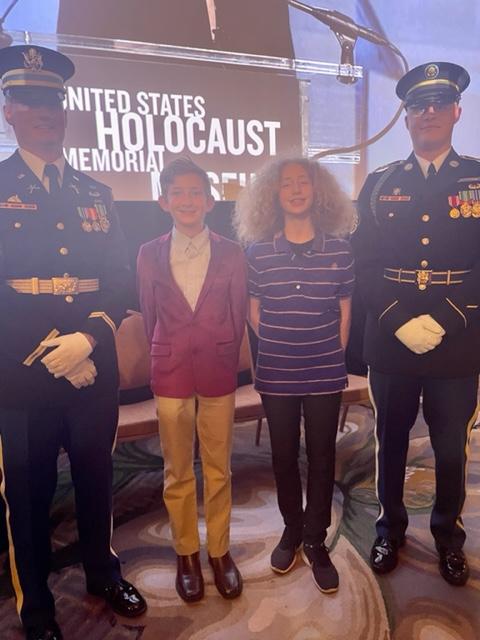
Arno Mayer received the Elie Wiesel award at the National Tribute Dinner for his participation as one of the Ritchie Boys.

- Princeton Faculty Resolution Honoring Arno Mayer -

Arno Joseph Mayer, Dayton-Stockton Professor of History emeritus, died on December 17, 2023, at the age of ninety-seven. Arno, as he was known to friends and colleagues, was born in Luxembourg, the son of well-off Jewish parents. The circumstances of his origins shaped a life that was eventful and at times tumultuous both within the walls of academe and without.

Tumultuous, first of all because the outbreak of war in Europe in 1939 forced the Mayer family to take flight. The path they took was a storied one, across France to Casablanca and Lisbon, and from there to New York Harbor, where the Mayers settled in Washington Heights, home to so many refugees like themselves. No sooner did Arno turn eighteen than he enlisted in the United States army, training first as a tank man. Arno’s language skills—he spoke French, German, and the dialect of his native Luxembourg—led to his recruitment into an intelligence unit based at a top-secret site in Maryland, Camp Ritchie. As one of the celebrated “Ritchie Boys,” his assignments included a stint as morale officer for a group of captured German rocket scientists, among them Wernher von Braun.

It was not obvious, when Arno mustered out of the army, that he was destined for a career in history. With funding from the GI Bill, he completed a degree in business administration at Baruch College in 1949. Arno then went on to earn a doctorate in Political Science at Yale in 1953, and, indeed, the first two jobs he landed were short-term positions teaching politics at Wesleyan and Brandeis. Not until 1958 did he join a history faculty, Harvard’s. He became a member of Princeton’s History department in 1961, where he remained until retirement in 1993. Arno’s origins and less than straightforward career trajectory left a lasting impression. He was always on the lookout for what he called diamonds in the rough, for people who may not have had all the advantages but who had a spark. The kind of history that he practiced was very much centered on politics and, above all, the politics of nineteenth and twentieth-century Europe. He wanted to understand the events that had thrown his life and that of his family into such turmoil. He looked at European politics, moreover, not from a national perspective—Arno was from a small country after all—but from a continental one. And he looked at them with a critical eye. Arno’s history was avowedly left-wing, but it was not so much about the downtrodden that he wrote as about the powerful whose schemes and ambitions he scrutinized with an unflinching gaze.

Arno wrote seven major books. He was not an archival historian so much as an interpretive one, and the interpretations he dealt in were sweeping in scope. In Wilson vs. Lenin: Political Origins of the New Diplomacy, 1917-1918 (1959) and Politics and Diplomacy of Peacemaking: Containment and Counterrevolution at Versailles, 1918-1919 (1971), the Versailles peace conference was Arno’s focus, but he opened out the subject in two ways. First, he examined the domestic political concerns of the negotiators, who, even as they haggled over Europe’s future, always kept audiences back home in mind. Second, just as much as peacemakers worried about the home front, they also worried about managing the fallout from the Bolshevik Revolution. Arno remained ever mindful of the domestic determinants of foreign policymaking, and in exploring this terrain, he was methodologically innovative. And Arno remained just as insistent that Versailles had been about more than redrawing Europe’s map or advancing the cause of democracy. It had also been about containing communism. The Cold War, on this accounting, did not begin in the 1940s but had a much longer pedigree, its origins dating back to the very moment of the Soviet Union’s founding.

The theme of counterrevolution continued to preoccupy Arno for the remainder of his career. It was a historiographical commonplace that Europe’s nineteenth century was a bourgeois century, middle-class people taking charge of the continent’s fate and directing it toward a future of progress and liberty. Arno’s take on the nineteenth century was altogether different, as the title of his magisterial The Persistence of the Old Regime: Europe to the Great War (1981) indicates. Bourgeois did not rule the continent as Arno saw it, so much as landowners, military brass, and churchmen. The Congress of Vienna of 1814-1815 had rolled back the gains of the French Revolution, allowing these old elites, as Arno liked to call them, to make a comeback in its aftermath. They were determined, moreover, to hold on against the forces of movement, even to the point of risking war. This go-for-broke strategy ended up marching the continent into the Great War, a catastrophe that finished off the old regime. The war also gave birth to communism, and even as it changed the face of revolution, it changed the face of counterrevolution. The struggles of the nineteenth century thus gave way to a face-off of a new kind: Wilson vs. Lenin, the very title of Arno’s first book.

Or almost, for the old regime, no longer in a position to dominate, still tried to play a role, making alliances in order to hang on to a vestige of power, even if only as a junior partner. Herein lay Arno’s interest in the so-called problem of the lower middle class, a swing group that had once leaned Left but which in the late nineteenth century soured on the ideals of the French revolution and turned resentful, providing social fodder for xenophobic and authoritarian movements that swept over Europe in the mid twentieth century. Old elites threw in their lot with such movements and helped to leverage them into power. In Why Did the Heavens not Darken?: The “Final Solution” in History (1988), Arno examined the cataclysmic results of this partnership, the destruction of European Jewry. The book became one of Arno’s most controversial, not so much because it exposed the role of elite institutions in mass murder, that of the Wehrmacht first and foremost, but because it made the debatable claim that the principal target of Nazism’s fury was not so much the Jews as Soviet Communism. What Arno did capture in the book was just what its title signaled, the furious nature of Nazism’s onslaught. The fury of the counterrevolution, its crusading, religious zeal and terrorist tactics, became the subject of Arno’s next major project, The Furies: Violence and Terror in the French and Russian Revolutions (2000).

Arno was well into retirement when The Furies was published, testimony to his unflagging energy. He brought that same dynamism to his teaching. Arno taught courses in Twentieth-Century European history, his charisma at the lectern and around the seminar table firing up vocations among his students, both undergraduate and graduate. Within the department, he was a consistent proponent, along with Robert Tignor and Stanley Stein, of expanding offerings in non-Western history. And with Lawrence Stone, Arno pioneered a course in historical methods, with a particular emphasis on the social sciences, which has since become a required first-semester seminar for all incoming History graduate students. Nor was it just in the classroom that Arno shook things up. During the Viet Nam era, he was active on campus militating against the war in ways that did not always endear him to the University administration. But Arno understood himself as a European intellectual in the Sartrean mold who had a responsibility to be engaged. The mention of Sartre’s name is also a reminder of the depth of Arno’s feelings for France where he maintained an apartment in Paris and a rural residence in Chérence in the Val d’Oise.

In all, Arno was a European and man of the Left. Europe’s self-immolation in the interwar decades brought a tide of such people to the United States, enriching American life on and off campus. Arno was part of a generational moment, but he was also an original, someone who could be provocative and charming by turns. Arno took ideas seriously, but his seriousness was always leavened by a puckish and irreverent sense of humor. We shall not see his like again.

Respectfully submitted,

William Chester Jordan

Philip Nord, Chair

Anson Rabinbach

Mister President: For the Committee I move that this Resolution be spread on the records of the Faculty; that a copy be sent to his sons Carl Mayer and Daniel Mayer, to his sister Ruth Burger, and to the Archivist of the University.

Flower

Send flowers

Share your sympathy. Send flowers from a local florist to Arno's family or funeral.
Arno Mayer Memorial Service at Princeton University Chapel Full Video
Helping hands

Add to his legacy

Please consider a donation to any cause of your choice.
$350.00
Raised by 4 people

It was in 1999 or 2000 when we met Arno Mayer. Arno often came to Luxembourg to see his mother who lived in the Jewish retirement home. At the same time, he was working on his autobiography and was looking for someone who could inform him about the political context of the thirties in Luxembourg. This is how a friendship was established between Arno, Janine and me and a big complicity was formed between us. Arno was for us like a brother, the messenger of another America that we did not know enough.

George W. Bush was in power in the United States, and Arno made us understand that this was not an accident of history. We talked a lot with Arno, about the Iraq War, about the decline of the American Empire, about the evolution of Israel. Arno considered Luxembourg as a kind of refuge, a counter-model, a haven of peace, a grass-roots democracy. We thought he was idealizing a little bit. Arno, for his part, warned us against our illusions about American democracy, the solidity of the Democrats, and Obama's rhetoric.

We started reading Arno's books, all the books. We found in it many "Luxembourgish" concerns: the right to exist of small peoples, the presence of the past in the present, the rejection of teleology and historical determinism, the rejection of ethnocentrism, the search for the structures of a transnational history, global as well as national, fidelity to a certain Jacobinism.

We were not the only ones to have discovered this new prophet of our country. His small house in Chérence gradually became a pilgrimage center for the young radicals of the new generation, the youth for peace and justice. The culmination of this dialogue across the ocean was a meeting "Arno talks about Arno" which took place in May 2004 at the Théâtre des Capucins in Luxembourg. It was the return of the prodigal son. The triumph of a heretic.

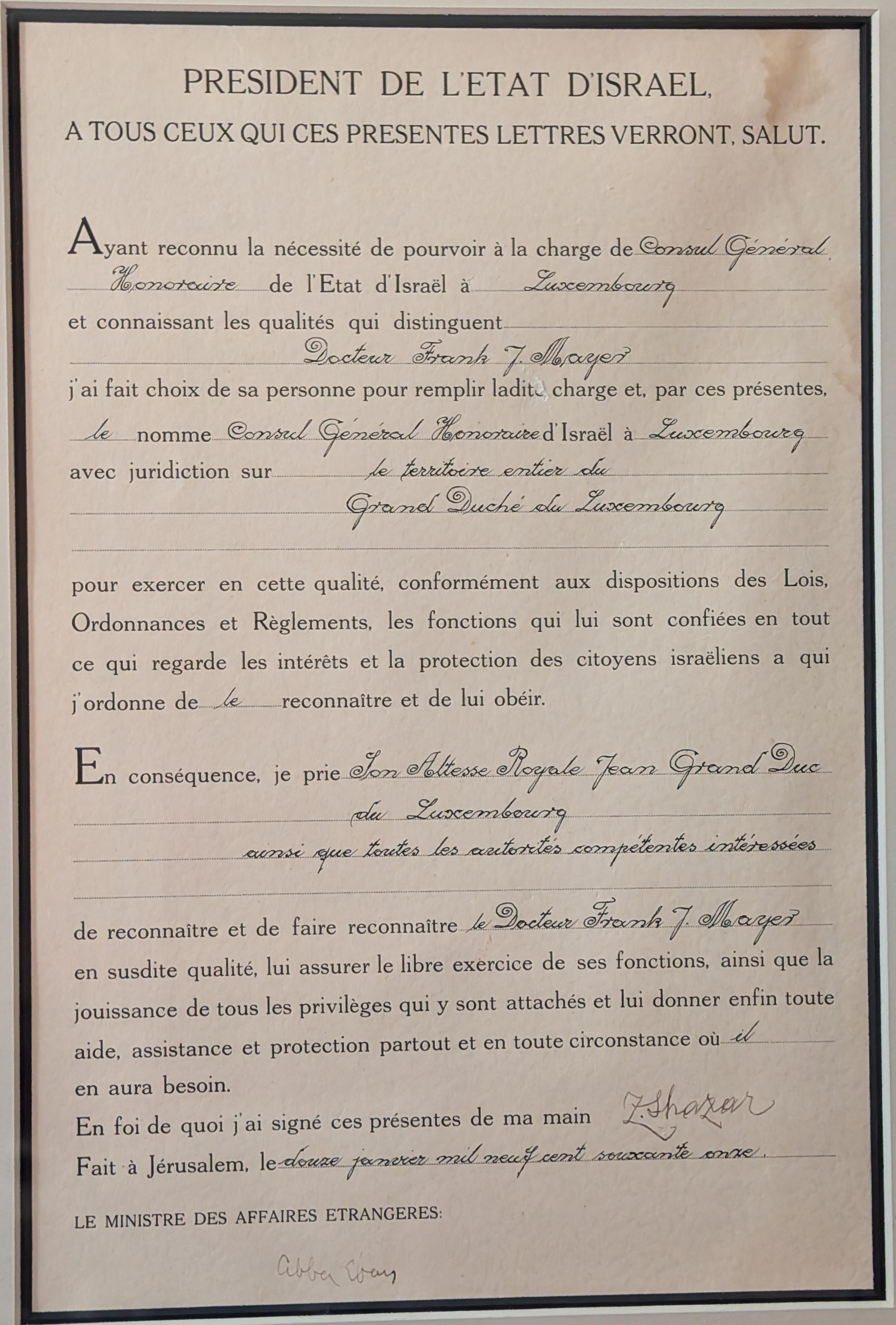
The next day Arno received a call from Jean, Grand Duke of Luxembourg, at the Hotel Cravat, where he was still staying. He said, "Come and see me!" The Grand Duke was the same age, they had left Luxembourg in 1940 during the same night. They were made to get along, to talk about everything without filter. We saw Arno for about fifteen years, then his travels became rarer. We were beginning to regret not having known him sooner. It would have changed our history, but we will remember his lessons, his common sense, his joie de vivre. 

Letter from the Prime Ministe…
2025
Letter from the Prime Minister of Luxembourg, read at Arno's memorial by the consul general of Luxembourg to the United States.
Video Testimonial sent by Ralph Nader (2 of 2)
Video Testimonial sent by Ralph Nader (1 of 2)

Arno was one of my father's (Stanley Stein) best friends. They were  colleagues in  Princeton History Department, kindred spirits, with a shared values, vision and commitment to the importance of history as a social as well as intellectual endeavor. 

I first met Arno when he came to our house after his arrival at Princeton in 1962 when I was 16 years old. I was immediately charmed and intrigued by his personal warmth, breadth of knowledge, quiet self-confidence (and yes, handsome dapper appearance) and willingness to engage a slightly intimidated adolescent. Over the past 16 decades, Arno became a virtual  member of our family, the person my father often spoke with and of,  my brother and sister admired and loved, as did their and my children, now grown and are also his fond admirers. From time to time, Arno would give us a call to chat, or as our parents  grew older, to express a helpful concern for my father or mother. He would also send us (and our grown children) books he thought might interest us. I/we will always remember how,  and whenever we met Arno he would greet us with a big hug, followed by a broad grin, saying How the hell are you?  We sensed that these (mild) swearing was his way of emphasizing his warm feelings for us and felt in a way flattered.

The last time I saw Arno was at the Mezza Luna restaurant in Princeton, where he, Bob Tignor and our dad meet almost every Friday for lunch. They came to be called by the restaurant staff, "The Three Musketeers,"  who carefully scrutinized the menu and then enjoyed their dishes. As usual, there were impassioned discussions about the state/s of the world, interspersed with often funny  comments and  poignant reminiscences of  past experiences. As you all know, Arno was a consummate story teller, some of which had become familiar to his two companions. A continuous thread throughout these many shared get togethers at Mezza Luna was a deep and loyal friendship of many years and a shared commitment to truth and understanding used to try to make the world a better place.

The Stein/Watson/McClurg family members will always love, remember and honor Arno.

Margot Stein

I first met Arno in the fall of 1969, shortly after arriving in Princeton, when he went out of his way to introduce himself at a reception for new graduate students. At the time I knew him only by reputation, through his magisterial books on the politics and diplomacy of World War I, and somehow envisioned someone aloof and intimidating, a scholar’s scholar knee-deep in footnotes. Obviously, I could not have been more mistaken: a scholar’s scholar indeed, but what a warm and wonderful human being! When I later summoned up the courage to ask if he would consider serving as my adviser, he readily agreed, as if it was the most natural thing in the world. There was no obvious reason why he should have been so willing to invest time and energy in a small-town Midwestern kid with a well-developed case of impostor syndrome, but he did. He may have seen more potential in me than I saw in myself; he could hardly have been more encouraging. As many others could no doubt also testify, Arno was a superb mentor. He never attempted to force junior colleagues—as he regarded his students—into a particular mold or embrace a particular orthodoxy. He was willing to let me find my own way, to make my own mistakes and then patiently help me find ways to rectify them. Well into my career I would benefit again and again from professional contacts he quietly arranged without my knowledge or initiative. Being Arno’s student, as I would have reason to remark on more than one occasion, carried a certain cachet. I could not be more grateful.

Regrettably, a recent injury prevents me from traveling and means that I will not be able to attend Arno’s memorial service in person as I had intended. But at the appointed time I will certainly be offering a private tribute from the diaspora.  

The History Social Club at it…
La Mezzaluna, Witherspoon Street, Princeton, NJ, USA
The History Social Club at its weekly Friday lunch, La Mezzaluna, Princeton — with Arno Mayer, Stanley Stein and Robert Tignor
Comments:
  • Please make sure you've written a comment before it can be published. If you prefer to remove your comment, you can delete it.
  • Sorry, we had some trouble updating your comment.

Ellen Schrecker

January 7, 2025

Arno, Me, and History

Arno made me a historian. A radical historian.

I first met him in 1959. I was a junior history major at Radcliffe. In those days, we had individual tutorials where we read books our tutors selected and then met in person every few weeks to discuss them. The guy I had been assigned to was boring, as were the books he assigned. I asked around and a friend’s senior tutor suggested Arno.

Arno was NOT boring. We bonded immediately. initially over issues of height. I am usually the shortest person in the room. Plus, I was also interested in World War I. I wrote my senior thesis on the British recognition of Czechoslovakia. In the process, Arno not only encouraged me to engage directly with primary sources but also cleaned up my prose. I can recall more than a few tutorial sessions devoted to topic sentences.

Unlike my much more academically sophisticated classmate, Charlie Maier, who was also Arno’s tutee and already knew German, I did not expect to go to graduate school. I was a completely unliberated female member of the silent generation and planned to teach high school for a few years until I got married -- preferably to a “Harvard man” – had children and began my “real” life. But Arno put me up for a Woodrow Wilson Fellowship. The Ford Foundation had shared the then-common concern about the supposedly looming shortage of Ph.D’s for the expected tsunami of baby boomers and actually encouraged women to apply. There was a problem, however. Applicants needed recommendations from three professors, and, although I won the Radcliffe history prize, except for Arno, only one other faculty member knew me. Was it a coincidence that it was one of the very few women on the Harvard faculty – Judith Shklar? Anyhow, I managed to finagle a letter from another professor in whose large lecture class I had done well and eventually got a Harvard Ph.D.

By then Arno had long since left for Princeton. But I had, too. My then-husband, John Schrecker, was hired to teach Chinese history at Princeton in the beginning of 1965 and I became a faculty wife. But I was also a graduate student in European history, albeit at another institution. At the time, I was working on a thesis about the French debt to the United States under a professor who never read anything I had written until I handed in a complete first draft of the dissertation. Fortunately, Arno took me on, allowing me to participate in the department’s thesis writers’ seminar that he and Lawrence Stone ran. After Harvard’s thoroughly hands-off system where, unless you were brilliant, assertive, or gorgeous, professors had no idea who you were – especially if you were a small woman – Princeton’s serious attention to its graduate students was a revelation.

But my relationship with Arno also had a political side. At the time I moved to Princeton in the beginning of 1965, I had been working with the Student Non-Violent Coordinating Committee in Cambridge. I maintained that connection once I got to Princeton until that phase of the Civil Rights Movement ended and the war in Vietnam heated up. As far as I can recall, Princeton’s anti-war movement began at Arno’s house. He convened frequent meetings of concerned faculty members and community activists who organized a teach-in, demonstrated, and worked with Princeton’s few undergraduate and graduate student radicals to protest against the escalating war in Southeast Asia. Because of my ex-husband’s knowledge of East Asia, he became, along with Arno and Michael Walzer, one of the most visible early anti-war faculty members at Princeton.

I became active as well. Bored by my thesis and still not sure I wanted to finish it and become a college teacher, I plunged full-time into working with a small group of faculty members collecting materials for a book about Vietnam. I spent months in the basement of the Princeton Library reading everything the university had on Vietnamese history and culture – which wasn’t much. I learned a lot about that country, but that project fell through. My collaborators dropped out and other anti-war activists got their books out sooner. (Actually, it was my second husband-to-be, Marvin Gettleman, who scotched our project by producing the very first and most widely-read volume on Vietnam then available in English.)

After John and I left Princeton in 1972, I remained in touch with Arno. He put me up in his apartment for a while when I did archival research in Paris, sent baby presents to my sons, and liked to give me advice about my far-from-flourishing academic career. Advice, I should add, that I probably should have taken, but didn’t. Although it took 13 years, I did finish my thesis but made no attempt to publish it or get a teaching job. Ten years later, I taught for two years as a full-time lecturer at Princeton and had the pleasure of being able to hang out with Arno and schmooze about our work and the state of the world. Then in 1987 when I did seek an academic position at the only school in New York City that was hiring a full-time tenure-track professor in my field that year, Arno was instrumental in my obtaining it. He used his very good connection with Yeshiva University’s only European historian to promote my candidacy.

By that point, I had abandoned European history. I had been teaching a course about the

U.S. in the 1950s during a stint as a Freshman Composition teacher at Harvard in the early 1970s and had discovered that there was nothing I could assign to my students about McCarthyism. So, with no desire to continue working on European history, I decided to write a book about McCarthyism and discovered my vocation. I have been writing about American political repression ever since.

Arno shaped my scholarship in ways that I’m still processing. Above all, he encouraged me indirectly – and more by his example than any specific directives – to view that scholarship as my political work. At the same time, he pushed me to adhere to the highest possible standards, explaining (although he didn’t always take his own advice) that because of my obvious political proclivities, my research would have to be more extensive than that of my less politically committed peers. Luckily, I love archives. As a result, even when I get blasted by critics for taking a nuanced position about the evils of American communism, they usually concede that my footnotes are impressive. Thank you, Arno.

Comments:
  • Please make sure you've written a comment before it can be published. If you prefer to remove your comment, you can delete it.
  • Sorry, we had some trouble updating your comment.
  • Please make sure you've written a comment before it can be published. If you prefer to remove your comment, you can delete it.
  • Sorry, we had some trouble updating your comment.
GUARDED BY THIRD INFANTRY WHI…
2022, United States Holocaust Memorial Museum, Raoul Wallenberg Place Southwest, Washington, DC, U.S.
GUARDED BY THIRD INFANTRY WHICH GAURDS THE PRESIDENT. — with ARNO'S GRANDCHILDREN SHANE AND NATHANAEL

Want to see more?

Get notified when new photos, stories and other important updates are shared.

Get grief support

Connect with others in a formal or informal capacity.

Recent contributions

$50.00
Stein Family
$100.00
Henri Wehenkel
$100.00
Victoria de Grazia
See all contributionsRight arrow
×

Stay in the loop

Prof. Arno Mayer