- Princeton Faculty Resolution Honoring Arno Mayer -
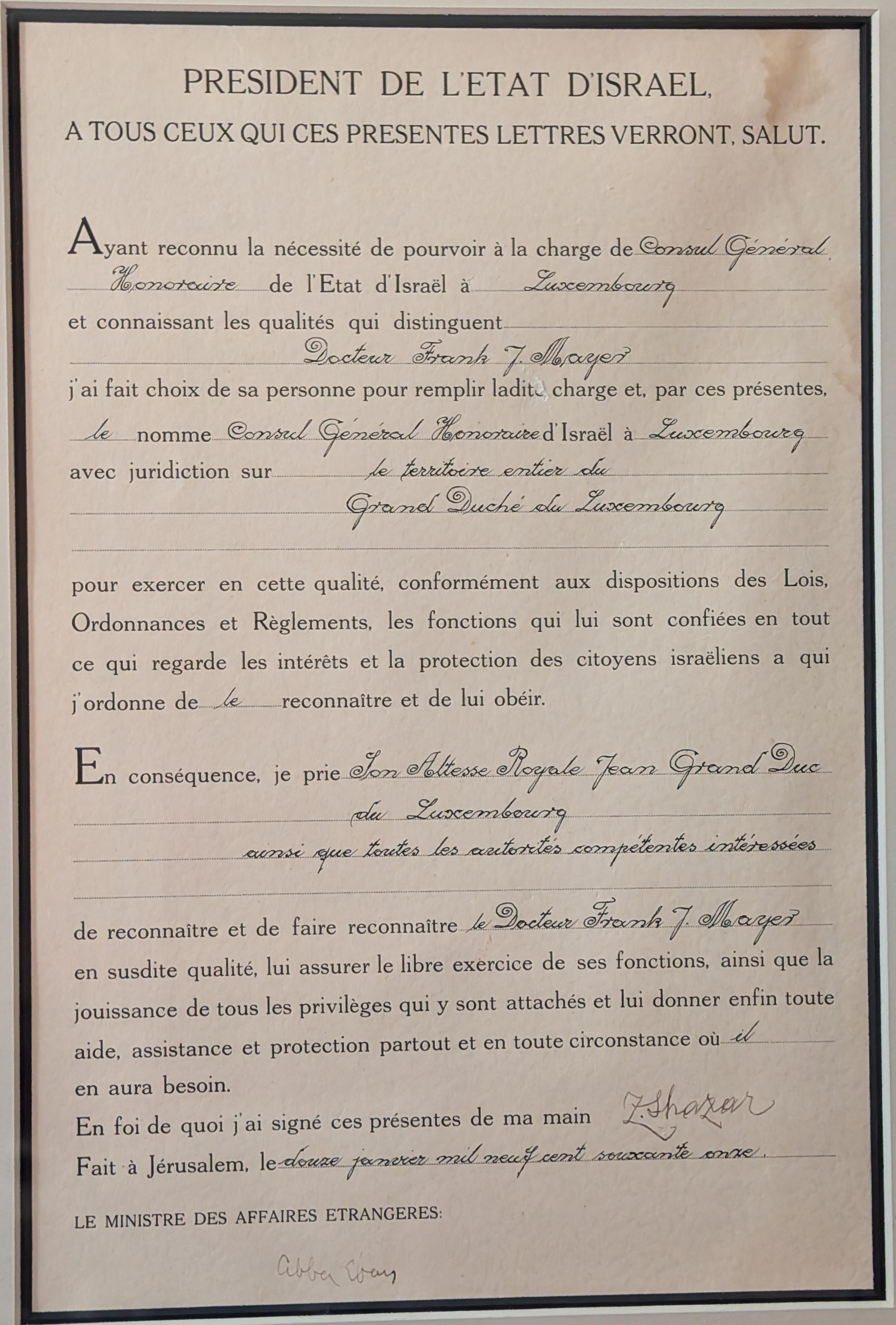
Arno Joseph Mayer, Dayton-Stockton Professor of History emeritus, died on December 17, 2023, at the age of ninety-seven. Arno, as he was known to friends and colleagues, was born in Luxembourg, the son of well-off Jewish parents. The circumstances of his origins shaped a life that was eventful and at times tumultuous both within the walls of academe and without.
Tumultuous, first of all because the outbreak of war in Europe in 1939 forced the Mayer family to take flight. The path they took was a storied one, across France to Casablanca and Lisbon, and from there to New York Harbor, where the Mayers settled in Washington Heights, home to so many refugees like themselves. No sooner did Arno turn eighteen than he enlisted in the United States army, training first as a tank man. Arno’s language skills—he spoke French, German, and the dialect of his native Luxembourg—led to his recruitment into an intelligence unit based at a top-secret site in Maryland, Camp Ritchie. As one of the celebrated “Ritchie Boys,” his assignments included a stint as morale officer for a group of captured German rocket scientists, among them Wernher von Braun.
It was not obvious, when Arno mustered out of the army, that he was destined for a career in history. With funding from the GI Bill, he completed a degree in business administration at Baruch College in 1949. Arno then went on to earn a doctorate in Political Science at Yale in 1953, and, indeed, the first two jobs he landed were short-term positions teaching politics at Wesleyan and Brandeis. Not until 1958 did he join a history faculty, Harvard’s. He became a member of Princeton’s History department in 1961, where he remained until retirement in 1993. Arno’s origins and less than straightforward career trajectory left a lasting impression. He was always on the lookout for what he called diamonds in the rough, for people who may not have had all the advantages but who had a spark. The kind of history that he practiced was very much centered on politics and, above all, the politics of nineteenth and twentieth-century Europe. He wanted to understand the events that had thrown his life and that of his family into such turmoil. He looked at European politics, moreover, not from a national perspective—Arno was from a small country after all—but from a continental one. And he looked at them with a critical eye. Arno’s history was avowedly left-wing, but it was not so much about the downtrodden that he wrote as about the powerful whose schemes and ambitions he scrutinized with an unflinching gaze.
Arno wrote seven major books. He was not an archival historian so much as an interpretive one, and the interpretations he dealt in were sweeping in scope. In Wilson vs. Lenin: Political Origins of the New Diplomacy, 1917-1918 (1959) and Politics and Diplomacy of Peacemaking: Containment and Counterrevolution at Versailles, 1918-1919 (1971), the Versailles peace conference was Arno’s focus, but he opened out the subject in two ways. First, he examined the domestic political concerns of the negotiators, who, even as they haggled over Europe’s future, always kept audiences back home in mind. Second, just as much as peacemakers worried about the home front, they also worried about managing the fallout from the Bolshevik Revolution. Arno remained ever mindful of the domestic determinants of foreign policymaking, and in exploring this terrain, he was methodologically innovative. And Arno remained just as insistent that Versailles had been about more than redrawing Europe’s map or advancing the cause of democracy. It had also been about containing communism. The Cold War, on this accounting, did not begin in the 1940s but had a much longer pedigree, its origins dating back to the very moment of the Soviet Union’s founding.
The theme of counterrevolution continued to preoccupy Arno for the remainder of his career. It was a historiographical commonplace that Europe’s nineteenth century was a bourgeois century, middle-class people taking charge of the continent’s fate and directing it toward a future of progress and liberty. Arno’s take on the nineteenth century was altogether different, as the title of his magisterial The Persistence of the Old Regime: Europe to the Great War (1981) indicates. Bourgeois did not rule the continent as Arno saw it, so much as landowners, military brass, and churchmen. The Congress of Vienna of 1814-1815 had rolled back the gains of the French Revolution, allowing these old elites, as Arno liked to call them, to make a comeback in its aftermath. They were determined, moreover, to hold on against the forces of movement, even to the point of risking war. This go-for-broke strategy ended up marching the continent into the Great War, a catastrophe that finished off the old regime. The war also gave birth to communism, and even as it changed the face of revolution, it changed the face of counterrevolution. The struggles of the nineteenth century thus gave way to a face-off of a new kind: Wilson vs. Lenin, the very title of Arno’s first book.
Or almost, for the old regime, no longer in a position to dominate, still tried to play a role, making alliances in order to hang on to a vestige of power, even if only as a junior partner. Herein lay Arno’s interest in the so-called problem of the lower middle class, a swing group that had once leaned Left but which in the late nineteenth century soured on the ideals of the French revolution and turned resentful, providing social fodder for xenophobic and authoritarian movements that swept over Europe in the mid twentieth century. Old elites threw in their lot with such movements and helped to leverage them into power. In Why Did the Heavens not Darken?: The “Final Solution” in History (1988), Arno examined the cataclysmic results of this partnership, the destruction of European Jewry. The book became one of Arno’s most controversial, not so much because it exposed the role of elite institutions in mass murder, that of the Wehrmacht first and foremost, but because it made the debatable claim that the principal target of Nazism’s fury was not so much the Jews as Soviet Communism. What Arno did capture in the book was just what its title signaled, the furious nature of Nazism’s onslaught. The fury of the counterrevolution, its crusading, religious zeal and terrorist tactics, became the subject of Arno’s next major project, The Furies: Violence and Terror in the French and Russian Revolutions (2000).
Arno was well into retirement when The Furies was published, testimony to his unflagging energy. He brought that same dynamism to his teaching. Arno taught courses in Twentieth-Century European history, his charisma at the lectern and around the seminar table firing up vocations among his students, both undergraduate and graduate. Within the department, he was a consistent proponent, along with Robert Tignor and Stanley Stein, of expanding offerings in non-Western history. And with Lawrence Stone, Arno pioneered a course in historical methods, with a particular emphasis on the social sciences, which has since become a required first-semester seminar for all incoming History graduate students. Nor was it just in the classroom that Arno shook things up. During the Viet Nam era, he was active on campus militating against the war in ways that did not always endear him to the University administration. But Arno understood himself as a European intellectual in the Sartrean mold who had a responsibility to be engaged. The mention of Sartre’s name is also a reminder of the depth of Arno’s feelings for France where he maintained an apartment in Paris and a rural residence in Chérence in the Val d’Oise.
In all, Arno was a European and man of the Left. Europe’s self-immolation in the interwar decades brought a tide of such people to the United States, enriching American life on and off campus. Arno was part of a generational moment, but he was also an original, someone who could be provocative and charming by turns. Arno took ideas seriously, but his seriousness was always leavened by a puckish and irreverent sense of humor. We shall not see his like again.
Respectfully submitted,
William Chester Jordan
Philip Nord, Chair
Anson Rabinbach
Mister President: For the Committee I move that this Resolution be spread on the records of the Faculty; that a copy be sent to his sons Carl Mayer and Daniel Mayer, to his sister Ruth Burger, and to the Archivist of the University.


 0
0
 1
1





 Share with others
