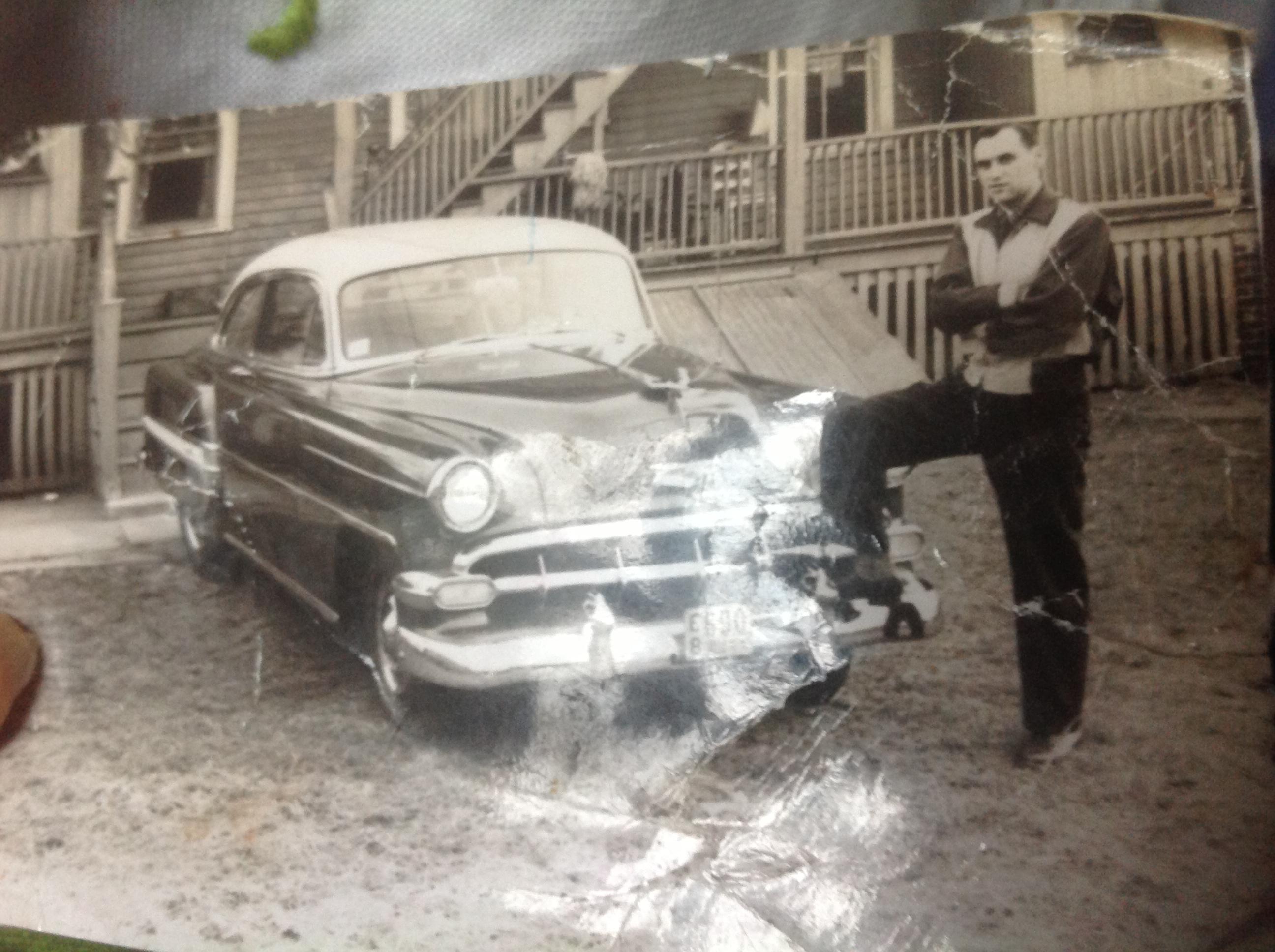
My father was born in Piotrkov, Poland in 1925 to a family of Ger Chasidim. A holocaust survivor who came to this country and started a new life. The image that people typically conjure up at hearing that description, could not be more different than my father. His father, was called the Hoicheh Shmiel or the tall Shmuel. And my dad was tall for an Eastern European Jew, though maybe not quite as tall as his immigration documents say. Sleek and strong like an athlete. There’s a picture of him with his leg on the hood of his 56 Chevy Belair wearing a bomber jacket, looking like a character in a James Dean movie.
His father was the Gabbai of the Schtarke Gerre Shtiebl or the Strict Ger Synagogue. My dad remembered standing on the Bimah, so proud that his father was in charge of handing out Aliyot and honors. He said in the camps they kept a minyan and davened on Yom Tovim as best they could.
I suspect my dad didn’t just stand, quietly in awe though. He likely had some ‘Mazik’ (a child who damages things) tendencies. Which is just as well since he had a natural gift for fixing things. He said as a kid they would ride bicycles. Or play ball. Always go, go, go. My dad’s claim to fame, was his hotel business being mentioned in New York On Ten Dollars A Day. Mr. K they called him. At Ateret Avot they would say, Mr. K and he’d answer “All the Way”. And that was him. Full speed ahead. With his whole heart always. Ten years ago, my dad had surgery for cancer, which he also overcame. Here was a man in his eighties rushing down the hallway with an IV pole and the nurses complained they couldn’t keep up with him. He was still rushing down hallways in his walker, at 92. Always saying “I don’t need a cane. I feel young. This walker is just in case I fall.” When he called him and “alte Zaidy” (alte, meaning old), Yiddish for Great Grandfather, he’d say “No, I’m a young, alte Zaidy.”
Once he was driving in Kew Gardens Hills when a teenage girl arguing with her mother, ran into the street, right in front of his car. He swerved and managed to avoid hitting her. The mother was so grateful. He must have been in his late seventies and still had the quick reflexes of someone half his age.
Piotrkov was the first ghetto in Poland and a center for the resistance. My dad said he tried to meet up with partisans but didn’t find anyone. Before the war his family had a coal and metal works yard. Not your typical Shtetl occupation. Piotrkov was a city of around 50,00 people, almost half Jewish. That’s all gone now. According to Wikipedia, (yes, Piotrkov has a Wikipedia page) the city is now an Ikea Distribution Center.
His father died of illness before the war and he did his best to help his mother, two younger brothers and sister. He was taken to do slave labor at a nearby glass factory and one day he came home and nobody was there. At the time he thought they were taken to a slave labor camp but they likely went to Treblinka and he never saw them again. He told us his mother had left him a care package with clean laundry. Everything for her children. My father was the same.
In computer support, they talk about Just in Time training. Like when you call a computer help desk and ask “How do you do this in Excel” and the person says just a moment, while they look it up online. My dad had that ability and it probably saved his life. Whatever he needed to do. He found a way. My mother told the story of how my dad called the plumber and then spent hours watching him. What was he doing? He said, “Next time, I won’t need to call the plumber.
Eventually my father was taken to Dachau. On the way their train was bombed and they were forced to march for weeks. My father was very weak. His cousin Alex saw him and tried to help but couldn’t. That same cousin later asked a “Landsman” (person from the same town), what happened to my father? The man told him he’d seen them put my father with the dead and not to bother looking. But the Americans liberated the camp and they checked every person to see if they were breathing and they rescued my dad. He woke up in a hospital and met a man who’d married my father’s cousin. She saw my father alone, and said “You lost your mother, so I’ll be your mother. And she meant it. Our Doda Hela and Dod Cheskel came to the United States too and looked after my father for the rest of their lives. When their daughter Susan got married, Doda Hela said to me, you’re still my Grandaugher.
There’s a line from a song called Hatikvah HaNoshanah. The Ancient Hope, a song we performed in choir. Based on the same poem as the Israeli National Anthem which he enjoyed singing with my mother.
שִׁמְעוּ אַחַי בְּאַרְצוֹת נוּדִי אֶת קוֹל אַחַד חוֹזֵינוּ “כִּי רַק עִם אַחֲרוֹן הַיְּהוּדִי גַּם אַחֲרִית תִּקְוָתֵנוּ”. Hear, oh my brothers in the lands of exile, The voice of one of our visionaries, that only with the very last Jew, is the last of our hope!
That was my dad. He was still standing so he had hope. And it was that spirit and optimism that allowed him to live. To embrace life. Nobody could take away his joy. That belonged to him. A spirit he shares with Israel and the people who fought like there was no tomorrow because there wouldn’t be one, if they didn’t. Like my mother.
The story goes, my father visited Tel Aviv and saw my mother on the street and said to his friend Eleazar “That girl I’d marry” and his friend said “I know the family”. And the rest is Kozlowski history. They were genuine friends and partners. Two different yet complimentary, peas in a pod.
They were so different. My mother, analytical, methodical. And my dad quick and intuitive. But they shared that determination to do what is good and kind, and she loved him all the more for knowing what he went through and still being able to feel that way. Israel was just a crazy dream when my father was born. He watched it become reality and marveled that we have a state, an army. That we didn’t need to rely on anyone. We could defend ourselves. And flourish. My parents loved to sing and in later, years that was how they communicated and connected. They would say “We don’t fight. We sing”. Hopefully the rest of the world will catch on.
My father made a good life for himself and his family. He was so proud of his grand children and now great grandson. He joins our mother once again, looking out for all of us and giving us hope.