

Dr. Luther Karl Branting


-
-
-
-
-
-

In lieu of flowers
Please consider a gift to American Indian Science and Engineering Society or Union of Concerned Scientists.


 Photo
Photo
Luther's obituary
Luther Karl Branting passed away unexpectedly on July 18 at the age of 71 after a brief battle with a MRSA infection that cascaded through his body due to the immune-suppressing effects of COVID-19. He would be as stunned as we are.
Karl was born in Little Rock, Arkansas, on November 16, 1952, to Leland Reinhold Branting and Audrey Berniece (Cline) Branting. He was raised in Salt Lake City, Utah; when he was 7, his mother took him to Clarksville, Arkansas, for a year where he had many memorable adventures with his cousins. He briefly picked up a southern accent and learned to love movies, devouring upwards of three per week at the local cinema. Cowboy movies and horror films had particular resonance, as long as there was no kissing.
When he was 9, his father moved the family to Aurora, Colorado, where he opened a law practice and where Karl spent the rest of his childhood. Out of necessity, he had to grow up quickly, taking care of himself and developing intense interests in nature, science, chemistry, music, and aviation. He spent many unsupervised hours cooking up dangerous chemical concoctions, at least one of which resulted in a minor teargas leak in the house. He often told the story of blowing up an abandoned washing machine in a field, shuddering at the thought of all the dumb and dangerous things he had done in his youth. Reluctant to both relive these exploits and inspire his young son, Karl never revealed some of these misadventures.
In high school, Karl was active in both the choir and orchestra and was a self-professed terrible student. He was a talented and enthusiastic chess player until he decided he wanted a girlfriend, and chess became less important. (He did retain a lifelong love of the game, teaching his son to play and reading books and news about the chess world). A budding violinist, Karl often talked about starring in a school production as “the fiddler” in Fiddler on the Roof.
After high school, Karl signed up for a multi-week adventure in the Colorado mountains with Outward Bound; he loved talking about this grueling experience. It changed his view of himself and gave him a newfound confidence. He may never have gone to war, but he went to Outward Bound!
Karl attended the University of Colorado in Boulder, majoring in Philosophy while also taking classes in music composition. He dropped out for a year, but returned with a new sense of purpose, applying himself vigorously to his studies for the first time. He was helped by his mentor and lifelong friend, philosophy professor Wes Morriston. During this time in Colorado, Karl led an adventurous life camping, traveling, and rock climbing with friends. He was particularly proud of having climbed the 20,549-foot Ecuadorian mountain Chimborazo. There were other climbing adventures; this was his Everest.
Thinking he should follow in his father’s footsteps, he went on to study law at Georgetown University in Washington, D.C. In his telling, he was so poor that he could not afford to date and survived on lentils and Rice-A-Roni. During his graduation ceremony, he knew in the pit of his stomach that becoming a lawyer had been a mistake. Nevertheless, after graduating, Karl worked at a private, Denver, Colorado, law firm for two years, handling divorce cases and arranging for the repossession of Mac trucks. He found these duties…distasteful.
During this time, while attending the Telluride Film Festival, he experienced a meet-cute for the ages when his future wife Susan picked him up during a rainstorm; he had an umbrella, and she didn’t. Their relationship was strengthened by their love of running, travel, cross-country skiing, and other outdoor adventures. Karl had a towering intellect and curiosity that Susan found appealing (his physique didn’t hurt either!) and he, in turn, was dazzled by her wit and self-assuredness. They were married in 1983 on the top of Flagstaff Mountain in Boulder, Colorado. Karl loved Susan fiercely and was a devoted husband for their almost 41 years of marriage.
After leaving the private law firm, Karl worked as a staff attorney for the Colorado Court of Appeals, where he wrote opinions for the appeals court judges. This scholarly work was more up his alley, and he enjoyed the intellectual challenges — and gossip — that came from reviewing appellate court cases.
However, unsatiated by his time as a lawyer by day, Karl fed his curiosity by taking night classes in computer science. He bought an early home computer and delved excitedly into its inner workings. Eventually, he decided to apply to graduate school at the University of Texas at Austin. He was accepted despite not having any degrees in computer science (although he did get a perfect score on the SAT!). The young couple moved to Austin in 1985.
His time in Austin included not only the hard work of graduate school, but also marked a turning point in his life when his son, Eric, was born. An adoring and engaged father, Karl always said that Eric was the light of his life.
He immediately began to hone his signature arsenal of dad jokes.
At graduate school Karl formed lifelong friendships and, under the mentorship of his graduate advisor Bruce Porter, learned to be a great teacher and academic. He received his Ph.D. in computer science in 1990 and accepted a position as a professor of computer science at the University of Wyoming, in Laramie. (When the family left Austin in late December, it was 70 degrees; when they arrived in Laramie, it was 20 below. They eventually adjusted to the shock.)
Karl worked at the University for 10 years, taking one year off for a research sabbatical in Germany at the University of Kaiserslautern. Among his many research projects, Karl and his graduate student John Hastings developed a program, KARMA, that helped ranchers with grasshopper control. He also researched case-based reasoning, an early form of artificial intelligence. He was particularly interested in applying his computer science knowledge to the legal realm. Karl often said that his career was focused on the intersection of Law and AI, though it took decades for the legal profession to show an interest in applied AI.
During his time at the University of Wyoming, the family traveled in the southwest, the mountains of Colorado, Costa Rica, and Europe. Karl was active in the Unitarian Universalist fellowship of Laramie. He taught Eric to ski, and spent countless hours running, camping, hiking, mountain biking, cross-country and downhill skiing. He hunted with his father-in-law, Richard Lappe, bagging pronghorns and also graciously accepting game he didn’t bag himself. The family ate well.
In 2000, Karl was one of four people in the United States to receive a prestigious fellowship to the U.S. Supreme Court. He worked at the administrative offices of the courts, developing a name-matching algorithm to determine if judges had potential conflicts of interest that is still referred to as the Branting Algorithm.
In 2001, Karl accepted a job from his good friend James Lester to work at James’ startup, LiveWire Logic, in Raleigh, North Carolina. When the company was bought, Karl found work at BAE Systems in Columbia, Maryland, and chose to commute back to Raleigh every weekend to be with his family, instead of relocating. This trademark generosity allowed Eric to finish high school without having to change schools, though it meant many hours on planes for Karl. When Eric started college at New York University, Karl and Susan settled in Columbia.
After a few years, Karl left BAE Systems to work for the MITRE Corporation, where he rose to the position of Chief Scientist. At MITRE, he tackled numerous projects, eventually applying for a number of internal grants to explore his longtime interest in using AI to provide practical help for federal agencies. He traveled extensively to present papers at conferences around the world, often bringing Susan along for a post-work vacation.
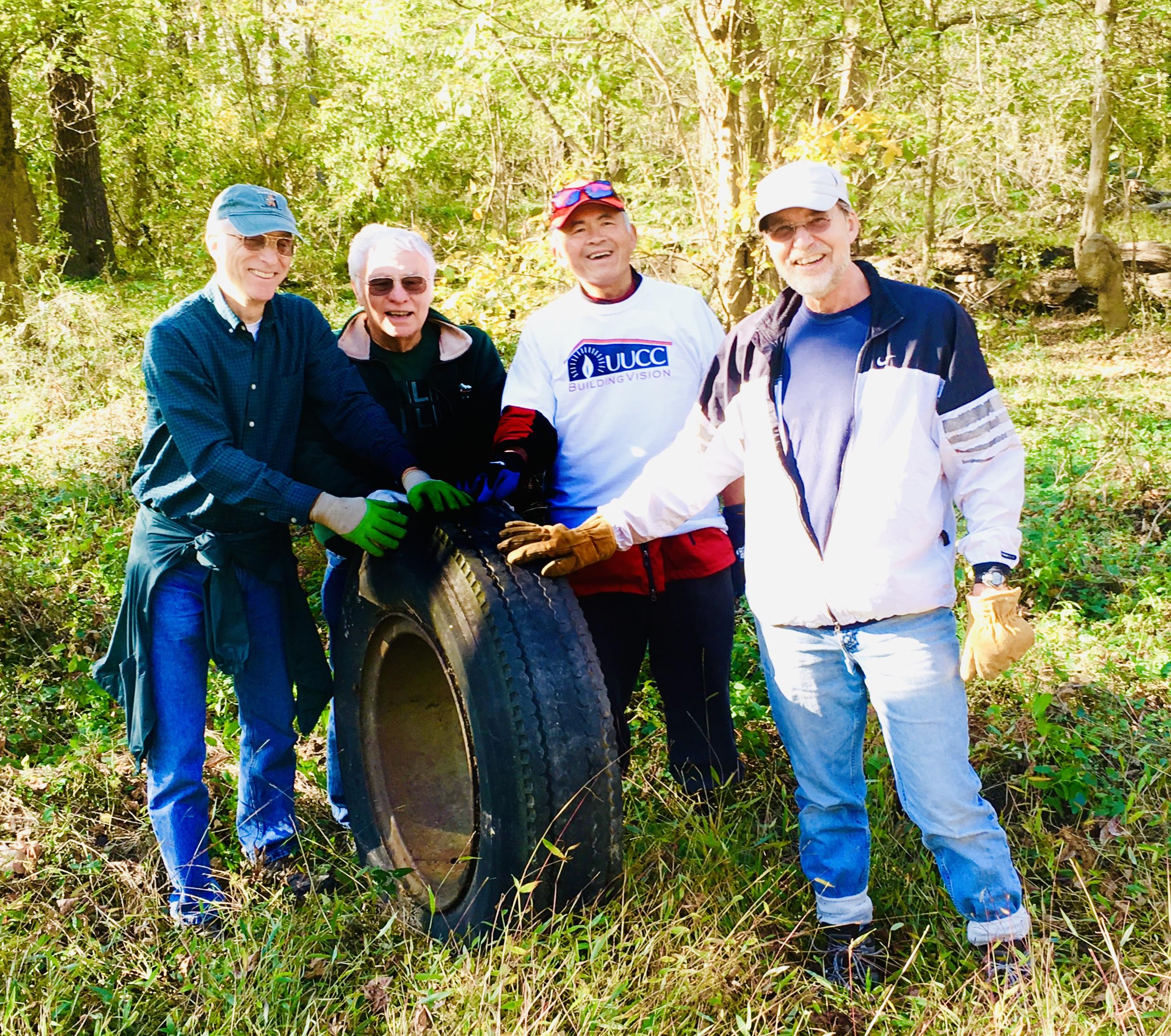
In Maryland, Karl was an active and contributing member of the Unitarian Universalist Congregation of Columbia for 14 years. He was on the board of directors for a term, sang as a tenor in the choir, and delivered 13 highly anticipated and well-received guest sermons. People still talk about his lively and engaging orations, which focused on various aspects of humanism. Karl also found time to compose music, and several of his compositions were performed by the UUCC choir.
With Susan, he was an avid member of the UUCC bike group; when the group dissolved, they became members of the Folks and Spokes bike group. To raise money for UUCC, they curated an annual, popular short film night, “Sundance on the Patuxent.” The congregation was the foundation of their social lives, and they made many deep friendships that last to this day.
Outside of Maryland, Karl enjoyed travel, often with Susan, Eric, and his beloved daughter-in-law, Lipica Shah. They had many adventures in Europe and Central and South America. He and Susan remained devoted to Eric, and they poured their hearts into maintaining a wonderful relationship with him and Lipica, visiting them often in New York City and making time to have a video call to catch up at least once a week.
In the latter part of his time at MITRE, the world finally opened up to the possibilities of artificial intelligence, including to its legal applications. Karl was surprised and delighted to find that others regarded him as one of the pioneers of Law and AI; his research papers have been cited over 2,000 times.
Karl gradually eased back from full-time work to become a kind of emeritus Chief Scientist at MITRE, and he continued to mentor and support the MITRE employees who took over his projects. He now had time to turn his attention to his passions: researching ways to use AI for social justice and writing a book for lawyers and computer scientists titled, “Equalizing Justice: Harnessing AI for Litigants without Lawyers.” This book was a source of enormous pride, and he spoke often about his hopes for the impact it could have and lives it could change for the better. There are plans to finish and publish the book posthumously.
In 2021, Karl was diagnosed with and subsequently recovered from prostate cancer, which shook him and opened him up emotionally during the last few years of his life. He leaned on Susan, Eric, and close friends during this difficult time, and all of us were honored to be a part of his support system. He spoke often about how grateful he was for this love and encouragement, especially from Susan, whom he considered his rock and his home.
Karl is survived by his wife, Susan; son, Eric; daughter-in-law, Lipica Shah; nephew, Paul Hoffman; Paul’s wife Stephanie and son Ryan; cousins Katrina Branting, Krisoula Faller, Sandy Dudley, Karen Waterman, Patricia Graham, Leslie Galloway Peresta, Barbara Maloney, Guy Galloway, and Curtis Galloway.
He is also survived by our extended family, Frances and Tony Moyer; Marie Considine, husband Padraic and son Viggo; Anna Newman, husband Kyle and daughter Isabel; Claire Moyer, husband Tyler Chlapek and daughter Lucy; Joe Moyer and wife Olivia Harris. He is preceded in death by his parents and his half-sister, Laura Jangla Audrey.
He was loved by many more people than he knew and will be missed deeply. He was a brilliant intellectual, voraciously curious, goofy and funny, and reflexively and instinctively empathetic. He would be touched and embarrassed by such an effusive obituary.
We love you forever.
 Send to someone
Want to stay updated?
In lieu of flowers
Recent contributions

Recent contributions


In lieu of flowers
Recent contributions
Recent contributions
Share this memorial website


 Share with others
 Donate in memory
