

Nancy Pendleton Law




 Photo
Photo
Nancy's obituary
Nancy Irene Pendleton Law
March 15, 1923 – November 25, 2017
Maryville, Tennessee
Nancy Law believed there was something good in everyone—and she lived her life as if that were unquestionably true.
It was not a belief born from ease. It was a decision she made early, and one she carried with her always.
She was born on March 15, 1923, in Princeton, West Virginia, into a life of modest means. As a child, she moved often with her family, sometimes to save just a few dollars a month. There was no hot water unless it was heated on the stove, winters were warmed by a single heater and heavy quilts, and much of life was built around making do.
But what she remembered was something else entirely.
“I was basically always surrounded by love,” she said. “Somehow I grew up thinking everyone was nice and you were polite and nice to everybody.”
Raised in a household of adults—her mother, grandparents, and extended family—she had no playmates her own age, but she was never alone. She learned by watching, by listening, and by paying attention. Her grandfather taught her to play checkers and never let her win. It didn’t bother her. She walked miles to school each day. At ten, she was told her premature baby brother was hers to help care for—and she did, forming a bond that lasted a lifetime.
She also learned something that would define her.
As a young girl, she noticed that her grandmother often worried about what might go wrong. Nancy made a different choice.
“In my seven or eight year old mind,” she said, “I decided it would be better to try to find something good in everybody and everything.”
That perspective became the foundation of her life.
She carried it with her to Concord College and then to the Medical College of Virginia in Richmond, where she entered a class of 86 students—only six of them women. Unaware that she was stepping into something uncommon, she simply said yes to the opportunity.
“I was very naive,” she said. “I didn’t realize that, in general, women didn’t do that.”
She graduated in 1948 in the top ten of her class.
Her path to medicine was not passive. When she learned she had been accepted, she asked for a single Christmas gift: a copy of Gray’s Anatomy. Before classes began, she arranged her own anatomy instruction, studying independently and preparing herself in advance.
It was in medical school that she met William McConnell Law.
In a class filled mostly with men, she had many invitations but remained selective. “I was not interested in fast guys,” she said. She noticed Bill gradually—first in passing, then in conversation. Their start was not immediate, but once it began, it settled into something steady.
“Soon after, he asked me for a date,” she said, “and never again did we go out with anyone else.”
They spent two years studying, working, and building a life together—taking the trolley to the park, quizzing each other as they walked, and sitting side by side in quiet hospital corridors after long shifts.
One day, what she thought was another trip to the park became something else. He led her into a church, down to the altar, and asked her to marry him.
“I was surprised,” she said, “but managed to say, ‘Oh, yes!”
They were married on June 30, 1947, and would spend the next seventy years together.
Nancy began her medical career with the same determination that had carried her there. During their early years, she worked in charge of the emergency room at the Medical College of Virginia, overseeing both the department and its ambulances, earning $300 a month so Bill could complete his training. She managed finances carefully, even securing a loan from her uncle to purchase their first car—a dark green Buick she loved—which carried them through years of training and into the beginning of their life together.
But as their family grew, the expectations of the time reshaped her path.
She stepped away from her medical career to raise their four children—Bill, Nancy, Sharon, and David. It was not a lack of ability, but a reflection of the era. She did what was needed, with the same steadiness she brought to everything else.
She ran a home with discipline and care. She sewed clothes, prepared meals, and managed a household built on thrift and intention. Having grown up with little, she believed in taking care of what you had, saving what you could, and making things last.
“All my life,” she said, “saving some of every bit of money I got was a necessity to me.”
That mindset built a life that was stable, grounded, and eventually expansive.
Together, she and Bill traveled the world—more than 40 countries across decades. But Nancy never traveled casually. Before every trip, she spent months reading, preparing, and learning.
As a child, she had once lingered over a picture of the Taj Mahal in an encyclopedia. In her seventies, she stood in front of it, walking through the place she had first encountered on a page—now understanding both its beauty and its story.
Reflecting on her travels, she said it felt “almost unbelievable to this little girl from the poor West Virginia mountains.”
At home, her life was equally full, though quieter.
She gardened, as her mother and grandmother had before her—first picking violets as a child, later tending her own flower beds, always finding satisfaction in watching things grow day by day. She loved strawberries and snapdragons, appreciating both their beauty and their reliability.
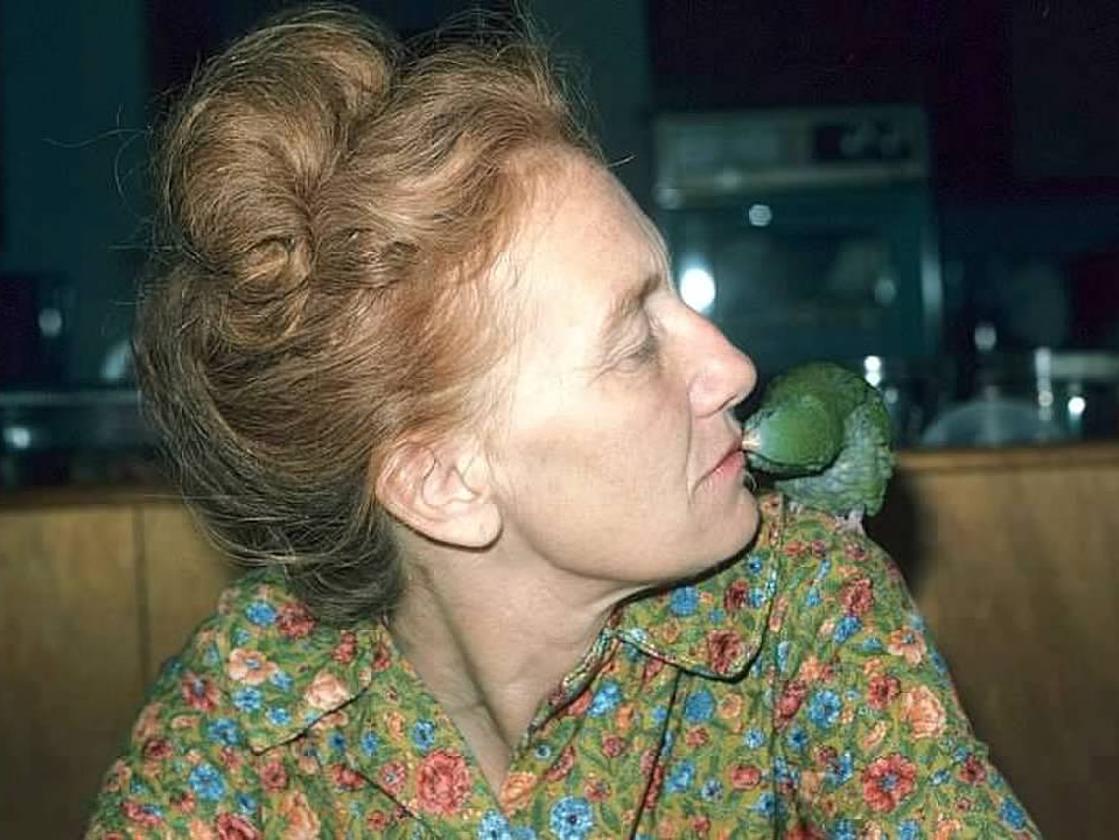
She watched birds with the same attention she had as a child, when, without playmates, “the yard was my world.” Over time, that attention became something more. With patience and consistency, she trained wild birds to trust her—feeding them by hand, calling them in, creating a small, quiet connection between herself and the natural world.
She carried that same thoughtfulness into her role as a grandmother.
In her kitchen, there was always “Grandma’s Row”—a line of jars filled with cookies, crackers, and candy, always ready for visiting grandchildren. It was simple, intentional, and entirely her: prepared, welcoming, and quietly generous.
Her marriage reflected the same steadiness.
“We told each other we would try to never go to bed mad,” she said. “If something bothered us, we would bring it up and thoughtfully discuss it.”
She added, almost as an aside, “We have never had an argument.”
Bill, in turn, said simply, “She hung the moon.”
Their life together was not without hardship. They lost their son David in 2000 after a long illness. They navigated the demands of his career, the raising of their children, and the care of aging family members. Through it all, Nancy remained what she had always been—steady, capable, and quietly resilient.
She believed in making decisions carefully, then moving forward without regret.
“Weigh all sides,” she said, “make a decision, and never go back and think, what if I had done differently.”
That approach served her well.
When Nancy passed away at home in Maryville, Tennessee, on November 25, 2017, at the age of 94, she left behind more than a long and accomplished life.
She left behind a way of living.
A way of paying attention. Of choosing optimism. Of building something steady and lasting over time. Of finding good—consistently, deliberately—even when it required effort.
She is survived by her husband, Dr. William McConnell Law Sr.; her children, Dr. Bill Law Jr. (Vickie), Nancy Law (Dr. Jay Gerdes), and Sharon Law Hammond (Curtis Hammond); and her grandchildren and great-grandchildren, who carry forward her perspective, her habits, and her quiet way of seeing the world.
She was preceded in death by her son, David Green Law.
Nancy’s life began in a small town, in modest circumstances, shaped by discipline and love.
It carried her farther than she ever could have imagined.
And through it all, she remained exactly who she chose to be.
 Send to someone
Want to stay updated?

Share this memorial website


 Share with others
