Lou and Mabel. On behalf of my mom, Mabel Zwobot, and our entire family, I would like to pass on our sincere condolences to you and your family. For the eight years that Lou was part of our lives, he was family too,
Dad spent his early career with the FAA performing flight inspection, a key component of American aviation progress has always been the airway and navigation system that today makes all-weather transcontinental flight unremarkable and routine. The Type II DC-3 became the standard flight inspection aircraft system wide for nearly twenty years, with the CAA eventually operating nearly sixty DC-3s. The prime mission of the DC-3 fleet was envisioned to be ILS and terminal approach inspection, plus the detailed commissioning inspections of all new facilities. Each DC-3 operated with two pilots and at least one airborne electronics technician, a crew concept that has carried forth to modern flight inspection. This is the last DC-3 inservice to flight inspection and I recall that that was one of the planes that Dad flew to help ensure the integrity and safety of the systems at our airports.
Dad was a pilot for Seaboard and Western Airlines and flew round the world trips delivering cargo such as tracking instruments for the early space flight in Kenya and picking up Rhesus monkeys from India for medical research. in 1959, we lived in Zurich Switzerland for 9 months while Dad flew . We bought a VW beetle and my sister and I returned home to the US in the VW on the plane. So we can say that we have crossed the Atlantic Ocean in a VW! This is photo of "Zurich Airtrader," N6502C, at Honolulu, June, 1956, which Dad probably flew. For more information about Seaboard & Western, see www.seaboardairlines.org.
My deepest sympathy and condolences on the loss of your father. He lived a wonderful life and he loved his family. I know he enjoyed your adventures in raising and showing goats as well as the horses. My thoughts and prayers are with him and you.
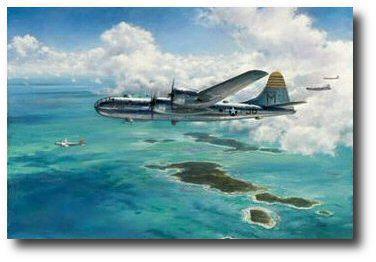
The "Eddie Allen" on its las mission, Dad's first. The Boeing B-29 "Eddie Allen" was far more than just another combat machine thrown into the effort to bring World War II to an end. Named after the famous Boeing test pilot Edmund T. "Eddie" Allen, the aircraft was paid for by donations from the employees of Boeing Wichita and given to the USAAF as a gift. Allen gave his life in the crash of the B-29 Superfortress prototype, trying to nurse the burning aircraft back to base in order to analyze the source of the problem. The "Eddie Allen" served its country well, flying 24 combat missions before being so badly damaged that it was almost unable to return to its Tinian Island base. The damaged aircraft was never to fly again and its remains were left on the small Pacific island.
"Enduring Eddie," flying over Tinian in the Marianas! The Eddie Allen was initially sent to India to the 20th Bomb Command, where it was assigned to the 45th Bombardment Group. In September 1944, it flew over the hump to China, and subsequently completed its first bombing mission over Japan. After many successful bombing mission, the plane was subsequently relocated to Tinian in the the Marianas, where Dad was co-pilot on his first and its 24th and final mission over Tokyo. In its 8 months of active service, the crews of the Eddie Allen bombed critical targets in the South Pacific, until it limped back to Tinian, unable to fly no more. The Eddie Allen was was truly a tribute to the engineer for whom he was named. It was the plane that ended the war.
"High Flight" was composed by Pilot Officer John Gillespie Magee Jr., an American serving with the Royal Canadian Air Force. He was born in Shanghai, China, in 1922, the son of missionary parents, Rev. and Mrs. John Gillespie Magee; his father was an American and his mother was originally a British citizen.