The English Department Office is one of my favorite places, and Tim is a big part of why.
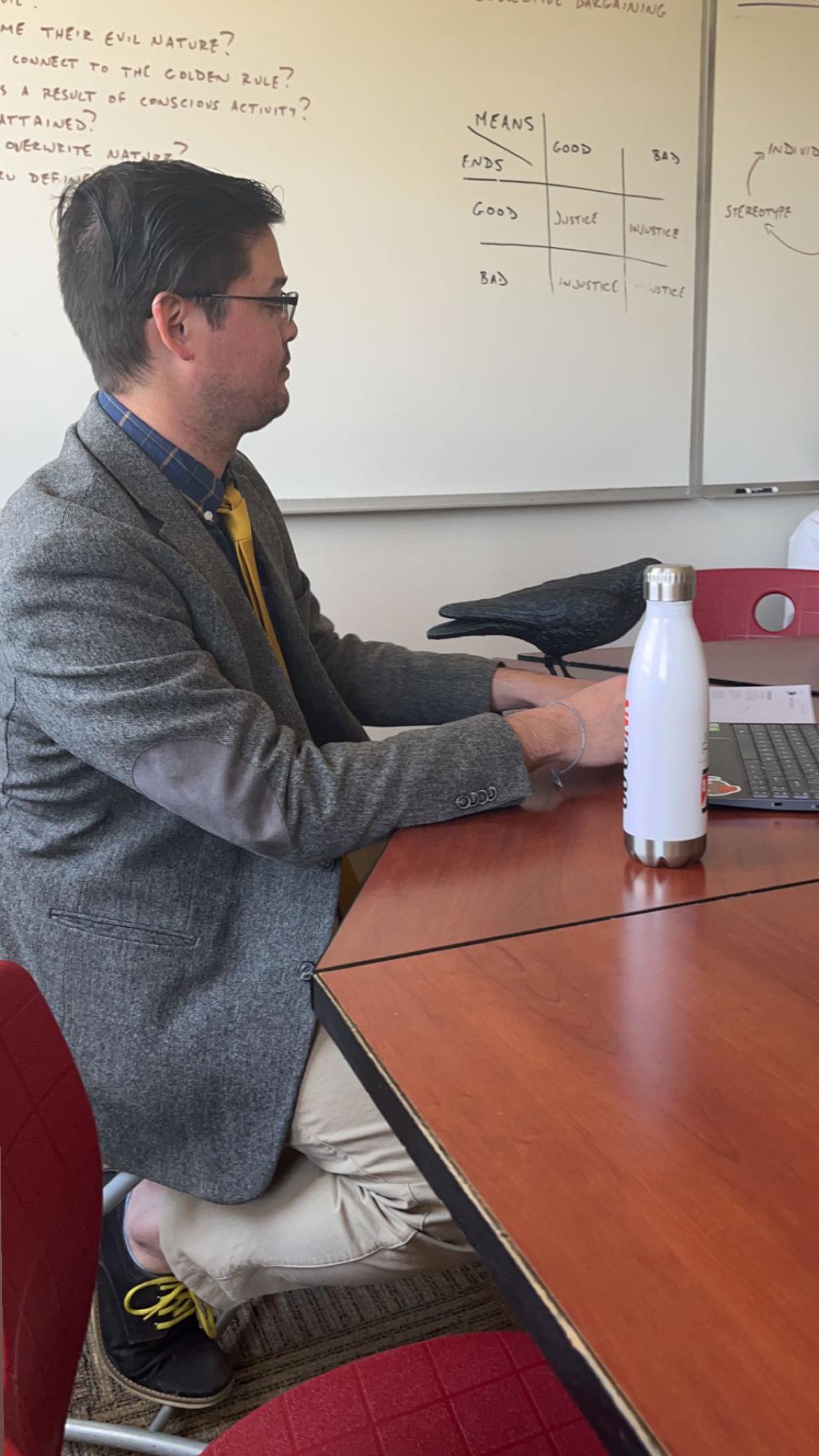
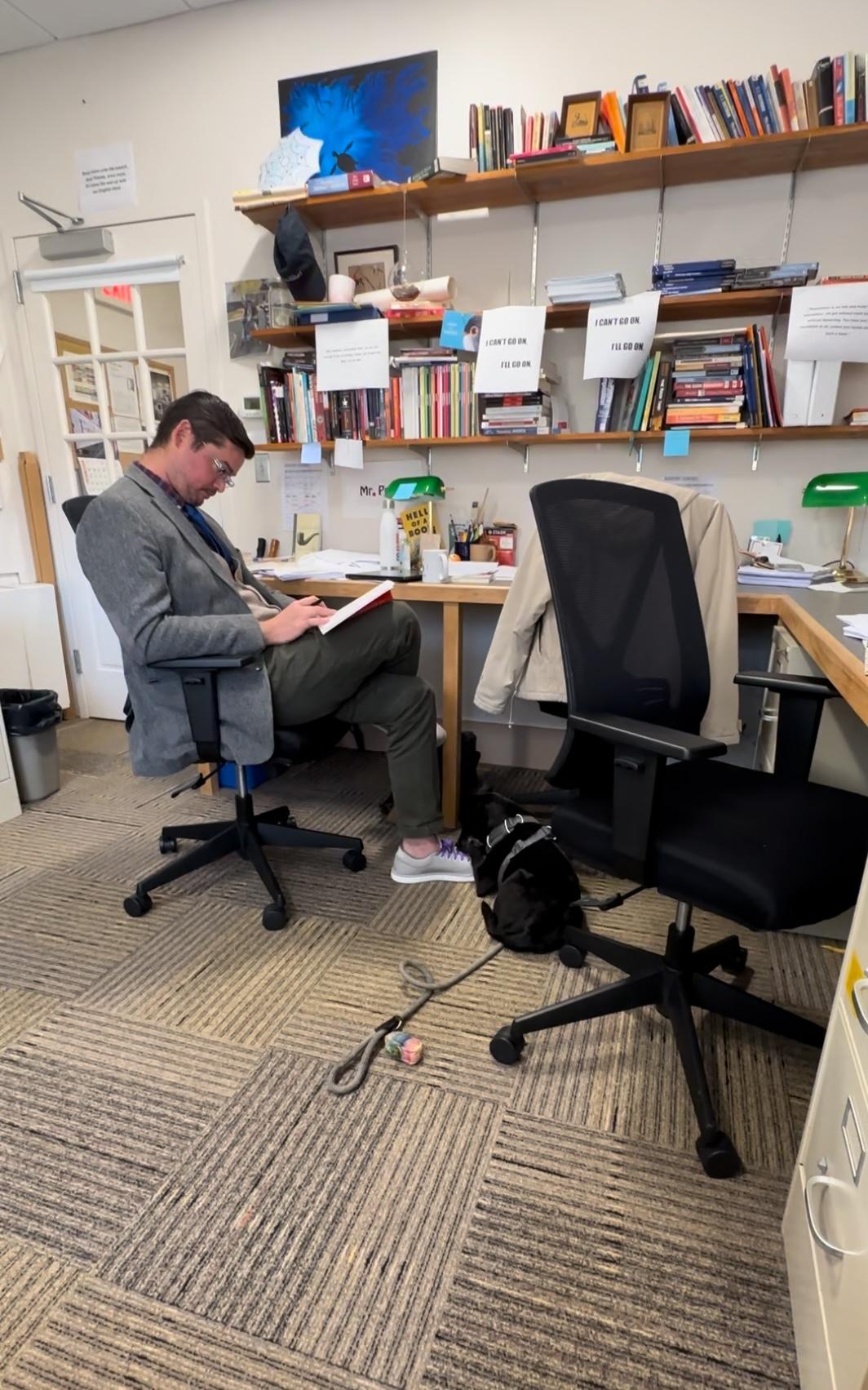
Tim’s desk is the first you encounter when you cross the carpeted threshold, and you could often find Tim sitting there, right calf crossed over left knee, book in one hand, pen in the other, and his mug, filled to the brim with black coffee, somewhere within close reach. When Tim’s Waffle House mug went missing, Tim declared it a crime and went searching.
He rarely (never?) wore socks, so we became quite familiar with the sight of the tattoo that wraps itself around his right ankle. Yet, I realized shortly after Tim passed that I never actually asked him what the tattoo said or meant.
Perhaps related, Tim often gave me the silence, space, and grace to babble in the office, and then eventually when I ran out of words, he would quirk an eyebrow or purse his lips and gift me a singular short sentence or pose a singular short question that either 1) made me think about things in a way I hadn’t before, 2) confused me, 3) made me feel better, or 4) all the above.
Tim’s absence is felt in many places around campus — his classroom where his Human Condition poster hangs (slightly askew), the back row of tables in the dining hall where, if you were lucky, you could witness Tim sitting across from a babbling pint-sized faculty child at brunch and responding intermittently as if said faculty child were a fully-grown adult, the library stool where he drank his first cup of coffee in the mornings, the common room of Van Sinderen where he lent his ear to senior girls before, during, and after check-in, his corner of the rink where he would stand, stance wide and hands in his jacket pockets, to watch some of his rowers and students play in their hockey games, the whole darn lake, the boat house, and certainly the English Department Office.
Tim has left behind a Tim-shaped hole, and at the moment I see this hole as not unlike the gaps of silence, space, and grace he often afforded so many of us. And, as a wise woman once warned,
“To fill a Gap / Insert the Thing that caused it — / Block it up / With Other — and 'twill yawn the more — / You cannot solder an Abyss / With Air.”
I choose to read this poem with hope and love.