Growing Up, Part III
In the 1970s, when Sid and Jen were in high school and then college, and I was in grade school, we took some wonderful family vacations abroad. I was five when we went to Spain and Portugal. One morning in Madrid, I heard the clomping of horse hooves on the cobblestoned street and Sid calling to me from outside the hotel. I looked down at the street, and, to my delight, there were Sid and Jen, about thirteen and fourteen at the time, riding in an open-air, horse-drawn carriage. My parents and I soon joined my brother and sister for a tour of the city.
During that same trip, a guitarist at a restaurant serenaded my sister. A waiter poured fruity and deceptively alcoholic sangria into her mouth. We spent Holy Week in Seville. I remember haunting music, a procession of spooky figures in pointed white hoods, and gory wax floats that depicted scenes from Christ’s Passion. On this trip and others afterward, we explored dark and mysterious places—caves in the Pyrenees and cathedrals lit by hundreds of long tapers. Throughout Europe, we climbed the spiral stairs of castle towers. For teenage Sid, and for all of us, these trips were much more than school breaks; they were windows into other worlds.
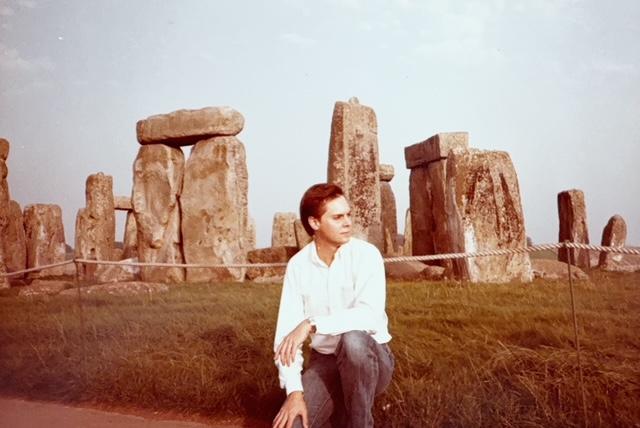
When I was eleven, we visited Stonehenge on a wet and blustery Christmas Day, and our umbrellas turned inside out. The pouring rain transformed the narrow roads into muddy, treacherous channels. Our rental car splashed through high hedges of stone and brush. Wherever we were supposed to go that evening, we didn’t make it there. We ended up staying in a shabby, freezing-cold inn. The boiled meat lacked flavor, and the vegetables were overdone. In hindsight, the people singing carols outside might have been beggars. My mother burst into tears when she saw them, and I couldn’t understand why. She said, “It’s Christmas and I wanted all of you to have a good memory.” Well, we had many adventures—and a few misadventures—but all of those times were wonderfully enriching for our souls.
On another trip to England, about a year later, Sid took me to the Marquee, the London rock club where the Rolling Stones had made their debut years earlier. The rest of the family visited Wimpleton that day. From my child’s perspective at the time, the last thing I wanted was to go somewhere to watch tennis. Sid suggested we go to the Marquee, which, unlike American clubs, allowed children because it did not serve alcohol. I remember it being spacious and well-lit, with cheerful red-and-white striped awnings. Excited to visit a cool, grown-up place with my sweet and handsome brother, I kept a Marquee flyer for many years.
Once, Sid took me to a rock club in Paris. By then, I was probably fourteen. Sid somehow knew a French family in Paris. They invited him to dinner, and he kindly took me along. Then a bunch of us went to a famed nightclub called Le Palace, where many people in their twenties and thirties were dressed in glamorous outfits, like in fashion magazines, and we stayed out until half the night. My parents were furious at Sid when we returned to our hotel so late.
Sid loved cemeteries, and I was lucky he brought me along. He enjoyed making impressions of gravestones on thin paper. We used large pieces of black wax, though once, when rubbing Houdini’s stone in a cemetery in Queens, New York, Sid used blue wax. I helped Sid collect tombstone impressions of many famous people. At London’s Highgate Cemetery, we made rubbings of the graves of Christina Rossetti, George Eliot, and Karl Marx. In Père Lachaise Cemetery in Paris, we gathered rubbings from Colette, Oscar Wilde, Gertrude Stein, and Isadora Duncan. In another Parisian cemetery, we made a rubbing of Arthur Rimbaud’s tombstone, which I sent to Patti Smith, the rock star.
Jen spent her junior year of college in Florence, Italy, and during that time, our family traveled together through Italy, Greece, and Turkey. We visited Roman catacombs and crypts in churches, where skulls from medieval plague victims were stacked in decorative pyramids. We toured Pompeii. In Naples, in a smoky movie theater, we saw the Italian version of “Jaws” — “Low Squalo.” The Italians were neither impressed nor frightened by the shark attacks, but the audience was quite vocal during the love scenes.
One terrifying afternoon, Dad took us most of the way up Mt. Vesuvius in a rental car. I remember the switchbacks without guard rails, small rocks crunching under the car’s tires, and slipping off the cliffs. The sky started to darken. My mother insisted we turn back. Somehow, we made it off that mountain alive.
Like Dad, Sid was fearless and loved to travel. Both had independent personalities that required them to work for themselves. Regarding historical and literary interests, Sid, my sister, and I inherited them from our mother.
I’ll share another travel story from this trip. We all loved Istanbul, and visiting it was Sid’s idea. I’ll never forget the stunning beauty of the Blue Mosque, with its large central dome, tall minarets, and thousands of vibrant blue tiles. When it was time to return to the U.S., we were stranded at the airport for two days because of a strike. I remember garbage was everywhere on the floor, and the guards had machine guns. During a security check, a guard took Sid aside. Later, back in the U.S., our family watched “Midnight Express” at the theater, and Sid started crying during a scene set in a Turkish prison. Sid said that at the Istanbul airport, guards took him to a room and made him strip naked. As a young American man around twenty, with shoulder-length hair, Sid probably fit the profile of someone who might be carrying drugs.
To read about the stage in our lives when Sid was going to film school in New York City and I was a high school student on Long Island, see part IV.






 Share with others
 Donate in memory
