Notifications

No notifications
We will send an invite after you submit!

Memories & condolences

Year (Optional)
Location (Optional)
Caption
YouTube/Facebook/Vimeo Link
Caption
Who is in this photo?
Or start with a template for inspiration
Cancel
By posting this memory, you agree to our Terms of Service and Privacy Notice.
This site is protected by reCAPTCHA and the Google Privacy Policy and Terms of Service apply.
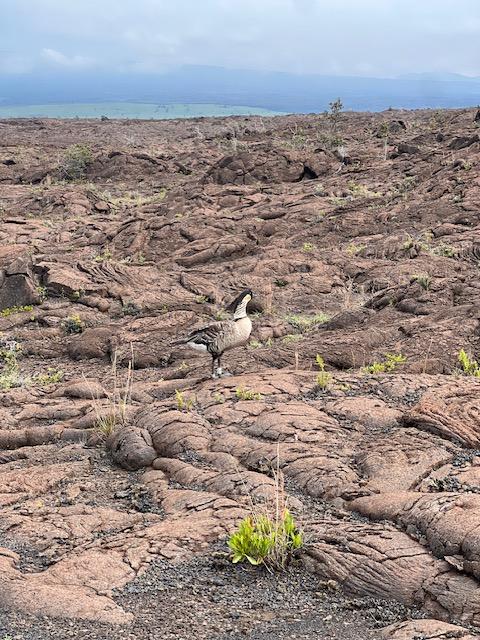
Walking back from spreading D…
2026, Ka‘ū Desert, Hawaii, USA
Walking back from spreading Dad's ashes at site 91-7, feeling full of love and also sorrow. A recent eruption of Kilauea volcano had spread glassy spongy tephra across the area. It felt very sere and lifeless. But then, rounding a small hill - there it was: a Nene goose! What are you doing out here? Perhaps you are Dickie's spirit - visiting Kelly and me as we walk back to our car.
Comments:
  • Please make sure you've written a comment before it can be published. If you prefer to remove your comment, you can delete it.
  • Sorry, we had some trouble updating your comment.
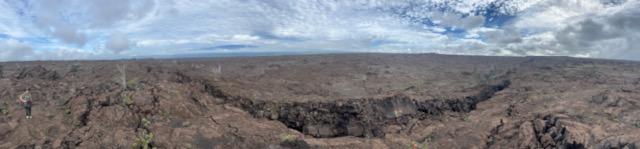
A 360 degree panorama where K…
2026, Ka‘ū Desert, Hawaii, USA - near station 91-7
A 360 degree panorama where Kelly and I distributed some of Dick's ashes.
Comments:
  • Please make sure you've written a comment before it can be published. If you prefer to remove your comment, you can delete it.
  • Sorry, we had some trouble updating your comment.
  • Please make sure you've written a comment before it can be published. If you prefer to remove your comment, you can delete it.
  • Sorry, we had some trouble updating your comment.
Near leveling station 91-7. D…
2026, Ka‘ū Desert, Hawaii, USA
Near leveling station 91-7. Dick was not very sentimental but would occasionally be moved by the raw beauty of a location. Tim Rose mentioned to me that Dad remarked to him once that this site was so extraordinary he wished some of his ashes were deposited there. "Dick loved the vista of the Kau desert to the north and the ocean to the south and west from 91-7. He referred to the area as “big country.” "
Dick conducted extensive rese…
2026, Ka‘ū Desert, Hawaii, USA
Dick conducted extensive research on Hawaiian volcanism, with the Ka'u desert being a primary field location. Situated in the rain shadow of Mauna Loa, the Ka'u desert is the site of the Koa'e fault system - which Dick and colleagues studied intensively. It is also a "paleo-plain" of relatively flat and undisturbed surface that has accumulated debris blasted out of Mauna Loa volcano. It is a dry and rocky landscape of pahoehoe lava flows and barren basalt surfaces - but occasionally punctuated by sprouting O'hea trees. Their shock of bright red tufted blooms are a startling contrast to the earthy landscape. The red blooms remind me of Dad's red Filson field vest, and I imagine these blooms are a tribute to his many traverses across the Ka'u plains...
I just found out about this as I have been out of touch with Dick for many years. He was on my dissertation committee at Hopkins, where he supervised my volcanological field work at Mount Rainier National Park. Dick was a generous and patient teacher, and I greatly enjoyed my brief time with him.  My condolences to all who knew this excellent scholar and very kind man

Volcano Watch is a weekly article and activity update written by U.S. Geological Survey Hawaiian Volcano Observatory scientists and affiliates. This week's article is by HVO scientist emeritus Don Swanson.

A geologist at HVO in 1965-1968, Dick continued his devotion to Kīlauea research for the rest of his career while employed at the Smithsonian’s National Museum of Natural History, including several years as the museum’s director. Much of his early research predated space-based volcano measurements, and his work tends be overlooked amidst more current data.

Dick, his wife, Pat, and their young family arrived at HVO in time for a small eruption in Aloʻi Crater on Christmas Eve and Day in 1965 and a stupendous episode of seismicity and ground breakage along the Koaʻe fault system extending west from Aloʻi into the Kaʻū Desert. As the window casings in their National Park house rattled with the earthquakes, Dick immediately started thinking of how such a small eruption could trigger such faulting.

Dick was disappointed that so little was known about the Koaʻe fault system and resolved to do something about it. He laid out leveling lines across the Koaʻe to enable future deformation to be monitored, and he established stations to measure movement of individual faults. Many of these leveling and fault-monitoring stations are still used today by University of Hawaiʻi at Hilo researchers. Data from these measurements led Dick and colleagues to publish interpretive papers about the nature of the Koaʻe fault system and its relation to the rest of the volcano.

At his home in Maryland, Dick constructed large physical models made of gelatin to emulate the shield volcanoes Mauna Loa and Kīlauea, and he injected colored water into them to see how the volcanoes deformed. These results supported the concepts that he and others were developing about the direction of the rift zones and how Kīlauea’s south flank moves. He joked that, when the experiments were over, his kids could eat the volcanoes.

While at the Smithsonian, Dick enabled museum exhibits celebrating HVO’s 75th anniversary in 1987 and arranged for publication of “gray literature” containing observations that HVO had produced over the years. This effort proves invaluable to current researchers.

In the late 1980s, Dick started returning to Kīlauea for several weeks every year, refurbishing and measuring the leveling lines across the Koaʻe. This led to questions about the frequency of faulting events and led to an attempt to estimate recurrence intervals of the faulting by examining the geologic evidence. This work revealed deposits of explosive tephra interlayered with the dominant lava flows. It didn’t take long before the explosive deposits became the primary interest, and that was the foundation for our current interpretation that Kīlauea can be an explosive volcano, not one that only erupts lava flows.

Dick’s concern with Kīlauea’s structure and history led him to worry quietly about what he perceived as an overemphasis on the “here and now“ of eruptions themselves. He pointed out that HVO is a Volcano observatory, not an Eruption observatory.

We met at Johns Hopkins University in 1961, when he and Pat returned from a postdoc in Japan and he resumed his work at Mount Rainier. I was a second-year graduate student working in an area near Mount Rainier. Since then, our research interests frequently intersected in Washington and at Kīlauea.

At a dinner at the Fiskes in early 1963, Pat suggested that I apply for a postdoc in Europe, which was successful and ultimately led to a USGS position. Dick suggested that I replace him at HVO in 1968 when he transferred back to the mainland. In 1980, he enabled me to use a Smithsonian electronic instrument (Geodimeter) to measure the movement of Mount St. Helens as it built toward its cataclysmic eruption. And it was Dick who invited me to join his research at Kīlauea in the early 1990s, ultimately leading to my return to the HVO staff later that decade.

The science of volcanology has lost a deep and questioning thinker, but his legacy endures and influences research today. His many friends and colleagues mourn his passing more than words can express. 

Grateful to Don Swanson and The Volcano Watch for publishing this lovely article about Dad's work on Hawai'i!

https://www.usgs.gov/observat…

Here

Comments:
  • Please make sure you've written a comment before it can be published. If you prefer to remove your comment, you can delete it.
  • Sorry, we had some trouble updating your comment.
Dick Fiske made it possible for me to work  in Laramie, Wyoming running a Smithsonian/University of Wyoming anthropology teacher training program (1983-1985) and then return as special assistant to the National Museum of Natural History Director (for him but soon thereafter Jim Tyler, Acting Director. ) By mentoring me, Dick changed my life, and I will never forget his kindness. He loved the institution, but he also loved research, and no one communicated love of science better. As he grew older, he became a model  – showing us all how to continue a passionate involvement in work long after retirement.  A kind, gentle, enthusiastic scientist, public communicator, and leader, he made an indelible impact on others and the world that will long be remembered.
My Uncle Dick had a quiet, measured manner. He was a devoted scientist; always analyzing the data.
Dick was extremely well respected and admired. In the summer of '69 when I traveled to Mammoth with Dick, Pat, Anne, and Peter, I was homesick at first, but then became interested in my charting responsibilities climbing Mt. Ritter and Mt. Banner. I had fun while Dick studied.
The many Holiday dinners in Homeland or Roland Park were very enjoyable. The reunion at Sherwood was superb. Dick even gave me his "yellow sub"! What a guy...
Raise a glass to Richard Sewell Fiske! Here here!

I miss my Uncle Dickie so much—mad scientist, mischief maker, fellow rock hound, playful pied piper, generous heart. My fondest memories (in no particular order): 

Famous Dickie—feeling so proud in 4th grade when Uncle Dick appeared as volcano expert in our class video. He could take the most complex material and present it in such a way that it was accessible and fascinating to everyone. Not many 9 near olds knew about plate tectonics, but I did! 

Rock Hound Dickie—He was the only adult as excited about my fossils and rock collection as I was. 

Mischievous Dickie—As director of the Natural History Museum at the Smithsonian, he gave us behind the scenes tours from the top of the dome in the main rotunda to the dark recesses of the basement where he said: "Bethie, come see what's inside this crate." I climbed the wooden step stool to a vat the size of an elephant. I'll never forget the whoosh and smell of formaldehyde. It took my eyes a moment to adjust to the darkness, but floating like some furry Ophelia lay a bright orange orangutan. (Years of therapy later.... ha ha!....I'm still laughing and feeling so proud that I was the chosen one.)

Pied Piper Dickie—4th of July at the Washington Monument in DC is something enjoyed by hundreds of thousands of people.  How would we navigate through the throng? Our over 6 foot tall Dickie held a cardboard poster tube high. With his wild hair and zealous eyes gleaming we all imprinted on this madly fun fellow and found our way. Spectators watched in bemused wonder. Some even followed along. 

Generous Heart Dickie—When my grandfather made our family a grandmother clock, the question was how to get it from Baltimore to Boise, Idaho. Simple! Dickie would hand-deliver it. Traveling in his old red station wagon, lovingly named "R Shark" he drove 2379 miles with a coffin sized clock in the back. Best of all, when he arrived, he made the "box" as special as the clock. Uncle Dick would crawl inside the "coffin" and wait until we children found our stealthy hiding places...thrilled and terrified that this crazed adult would emerge from his coffin to come find us! Such fun! 

"Bring me a rock" Geologist Dickie—Our most recent visit with Uncle Dick was filled with more play. Perched on his park bench, the geologist was "in." Those of us willing to take on the task, scoured the beach and brought forth our 'rock' offerings with trepidation, would they be good enough? The answer depended on the rock. Purely science (oh, and what would fit in neatly with his permanent collection in the big jar)!

Talking to Dickie was exhilarating. He could make anything fun and anything interesting. It's not every day that you meet someone in their 90s who still has a sparkle in his eye and such genuine curiosity about the natural world.  

Two days after his passing, my mom and I found ourselves on an 8 person Cessna in heavy turbulence. It was terrifying, but then I though of Dickie...who rode in helicopters over volcanoes and tiny submersibles 4500 feet below the surface of the ocean and I smiled. Somewhere in the universe, I felt that Dickie was cheering us on.

Thank you, dear Uncle Dickie, for the laughs and the learning and wonder and wildness! We love you so much!

 Your niece, Beth


Comments:
  • Please make sure you've written a comment before it can be published. If you prefer to remove your comment, you can delete it.
  • Sorry, we had some trouble updating your comment.
  • Please make sure you've written a comment before it can be published. If you prefer to remove your comment, you can delete it.
  • Sorry, we had some trouble updating your comment.
Last week, I met with Professor Kushiro and we talked about our memories of Dick. He kindly provided some precious old photos, which I have uploaded here.
Comments:
  • Please make sure you've written a comment before it can be published. If you prefer to remove your comment, you can delete it.
  • Sorry, we had some trouble updating your comment.
From Prof. Kushiro's photo al…
1985, Matsuzaki, 静岡県 日本
From Prof. Kushiro's photo album
Dick and Pat from Prof. Kushi…
1996, Washington D. C., コロンビア特別区 アメリカ合衆国
Dick and Pat from Prof. Kushiro's photo album
Dick, Ikuo Kushiro and his ni…
1994, University of Tokyo
Dick, Ikuo Kushiro and his niece from Prof. Kushiro's photo album
Dick, Pat, Kazue, and Ikuo Ku…
1992, Kyoto, Japan
Dick, Pat, Kazue, and Ikuo Kushiro from Prof. Kushiro's photo album
Comments:
  • Please make sure you've written a comment before it can be published. If you prefer to remove your comment, you can delete it.
  • Sorry, we had some trouble updating your comment.
Dick, Akiho Miyashiro, and Ik…
1992, IGC, Kyoto Japan
Dick, Akiho Miyashiro, and Ikuo Kushiro
Dick, Pat, Tetsuo and Kazue f…
1973
Dick, Pat, Tetsuo and Kazue from Prof. Kushiro's photographic album
Comments:
  • Please make sure you've written a comment before it can be published. If you prefer to remove your comment, you can delete it.
  • Sorry, we had some trouble updating your comment.
My interactions with Dick were mainly as a graduate student (me) talking to a senior scientist (Dick). At some point, probably an AGU meeting or something like that, we discovered our mutual interest in submarine volcanism. What I really liked about Dick was firstly his infectious enthusiasm and his passion for the science, and secondly his taking time to interact, on an equal basis, with a lowly graduate student. My sincere condolences to the Fiske family.

Dick was a friend and mentor. We met at Hopkins in 1961 when he and Pat had returned from Japan, and at a dinner at their apartment Pat suggested, and Dick seconded, that I apply for a NATO postdoc. I was Dick’s replacement at HVO in 1968 and tried to soak up his wisdom and insights about Kīlauea’s structure and dynamic workings. We partnered thereafter to support his ideas of south flank movement and how that impacted the rest of the volcano.

In the early 1990s I rejoined Dick, at his suggestion, in his continued efforts to monitor the Koa`e faul;t system. Dick led the way, soon joined by Tim Rose, as we discovered a marker tephra bed in the section of faulted lava flows. This serendipitous finding , enthusiastically pushed by Dick, eventually led to a sweeping investigation of the Kulanaokuaiki Tephra. Dick and later Tim took two trips a year to Kīlauea for the next 10 years. The observatory looked forward to their trips and the discussions with Dick about all things imaginable.

Dick was a fine public speaker and valued the importance of keeping the public informed about his research. No iconoclast, Dick took the time and effort to explain science to nonscientists. He never withheld information from his colleagues, either, sharing ideas and data withour hesitation. He emphasized the importance of long-term monitoring, inslalling and maintinaing crack-measuring sites and level lines, many of which are still measured today by Univeristy of Hawai`i at Hilo students.

Dick was a role model for many of us, an example of how one could be a fine scientist and human being at the same time. His legacy is broad and far-reaching and will long outlive his death. Pat and Peter, I offer my deepest condolences on the loss of a loving partner and father.

Hi Pat, I’m so sorry for your loss, you and Dick were my two favorite people in Washington, of course Dick hired me and for that I’m eternally grateful, I always thought he was an inspiration. I hope you are well,

Ann Rossilli sends her love and condolences too.   Love, Larry O’Reilly

When you smile anytime you meet, that's a good sign. I think Dick and I always met that way in NMNH or around DC

I worked at NMAfA when Pat was Assistant Director, and therefore met Dr. Fiske. He was indeed a scholar and a gentleman, and Pat was lucky to have him in her life for so long. My sincerest condolences to Pat and her family. 
5/14/98, Eating sushi (probab…
1998, Big Island, Hawaii, USA
5/14/98, Eating sushi (probably with spam in it) after a long day's field work on Kilauea Volcano
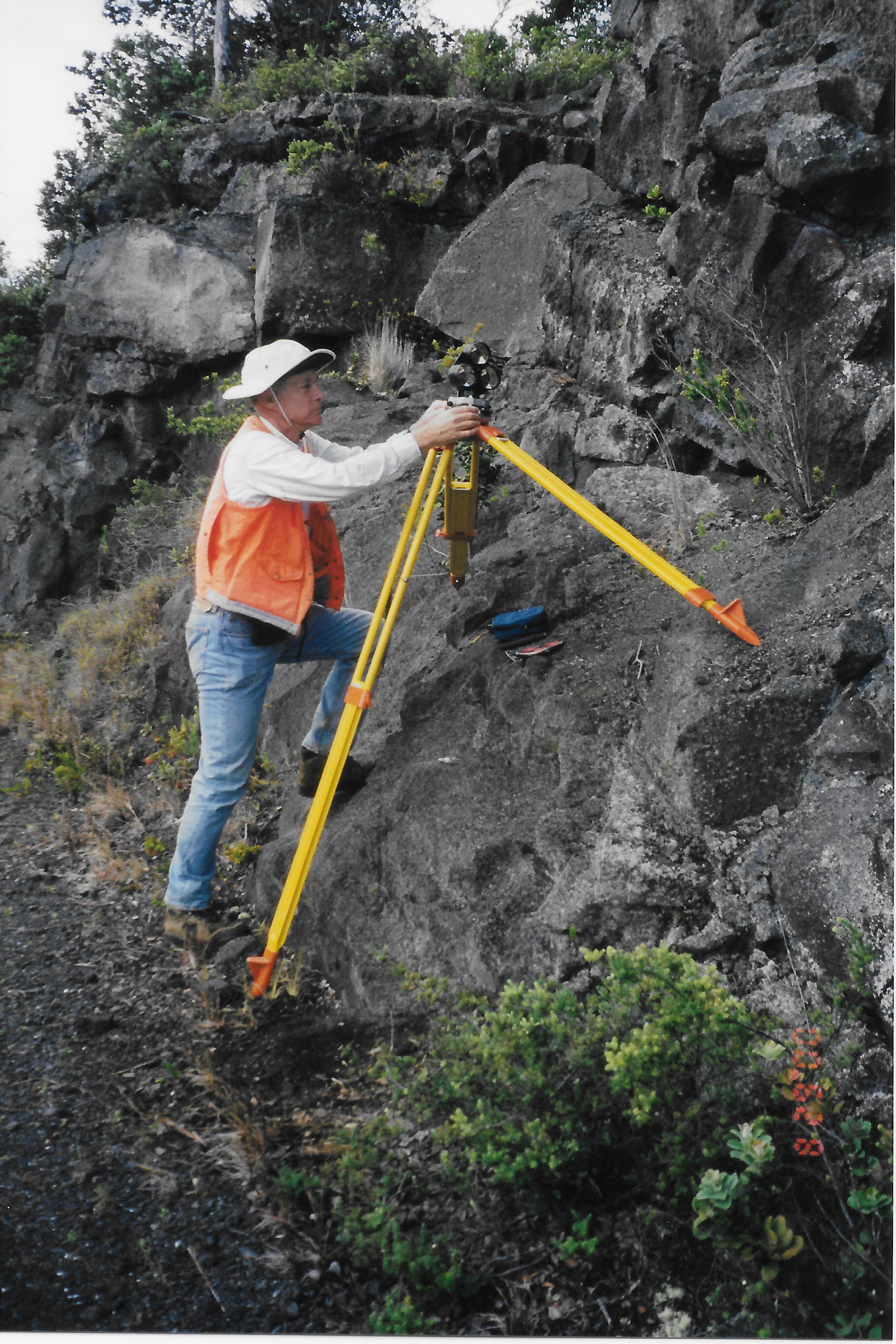
8/23/2000, Setting up a refle…
2000, Kilauea Volcano South Flank
8/23/2000, Setting up a reflector for electronic distance measurement across a crack

Want to see more?

Get notified when new photos, stories and other important updates are shared.
×

Stay in the loop

Dr. Richard Fiske