Notifications

No notifications
We will send an invite after you submit!

Memories & condolences

Year (Optional)
Location (Optional)
Caption
YouTube/Facebook/Vimeo Link
Caption
Who is in this photo?
Or start with a template for inspiration
Cancel
By posting this memory, you agree to our Terms of Service and Privacy Notice.
This site is protected by reCAPTCHA and the Google Privacy Policy and Terms of Service apply.
Comments:
  • Please make sure you've written a comment before it can be published. If you prefer to remove your comment, you can delete it.
  • Sorry, we had some trouble updating your comment.
Comments:
  • Please make sure you've written a comment before it can be published. If you prefer to remove your comment, you can delete it.
  • Sorry, we had some trouble updating your comment.
Comments:
  • Please make sure you've written a comment before it can be published. If you prefer to remove your comment, you can delete it.
  • Sorry, we had some trouble updating your comment.

My husband, Gary Golio, and I started studying T'ai Chi with Ed in 1979. How lucky we were that Ed settled in Hastings-on-Hudson! Ed became not only our teacher, but our mentor and friend. We shared many hours of conversation about Chinese philosophy, art, books, creativity, and life, usually over a delicious meal accompanied by peals of laughter. And what a good cook he was! Ed introduced us to the world of children's books, inspiring both of us to write for kids, and eventually he and Gary created two books togetherGary and I were fortunate to attend countless Chinese New Year potlucks, to be present at Ed and Filomena's wedding, to witness their joy at welcoming Antonia and Ananda into their lives and their pride in their beautiful daughters.  We helped demolish Ed's old studio. We went to the movies and ate rice pudding. We took a train to Baltimore.  When Filomena passed, we grieved with him. 

Ed received many honors; some were celebrated with picnics, some with fancy galas. No matter the setting or the company, Ed was always his humble, playful, generous self. We will miss him every day but will never, ever forget him.  

shared art by mail Ed is Virt…
Santa Cruz, CA, USA
shared art by mail Ed is Virtual!!!
I know how much pride and happiness Ed has for you both. He spread his wise and creative wisdom in my life over the years and I invited him out for a conference in Santa Cruz with Richard Lewis of Touchstone Foundation and Edith Sullwold who ran the children's program at the Jung Institute in Los Angeles. Also Ed was friends with George Levinson and  the Sadako Project. I felt lucky to know and work with them and communicate with them as a young teacher and artist but as friends. Ed sent me this funny and wonderful little piece he did and we would send things back and forth. I thought you would enjoy it..I know he is virtual now for all of us but especially for his beloved daughters.
Ed's inspirational insights will be missed. Here he is speaking about tai chi class...
Comments:
  • Please make sure you've written a comment before it can be published. If you prefer to remove your comment, you can delete it.
  • Sorry, we had some trouble updating your comment.
  • Please make sure you've written a comment before it can be published. If you prefer to remove your comment, you can delete it.
  • Sorry, we had some trouble updating your comment.

Ed was my teacher for many years. We met at Naropa Institute in 1981 and I assisted him in calligraphy, drawing and watercolor classes during the summer sessions. Eventually he allowed me to teach the straight line (ichi) brush practice. His wisdom lives inside and continues to enrich my life.

Here is a story from one of those summers when I brought him to meet my buddhist teacher Chogyam Trungpa.

Encounter

Twenty students sit at long tables and draw horizontal lines on sheets of newspaper with Chinese brushes and clear water. The room is quiet, with just the sound of brushes dipping, landing, moving slowly across the paper. We have been taught that the source of this brushstroke is the center of the body . This is the t’an tien in Chinese medicine located below the navel. As the strokes are made there is a shifting of weight from left to right, turning, leading the action from this center of the body. For three hours each morning we practice this movement, first standing then sitting at the tables, exploring where we are tense and holding, where to let go, drop down, allow energy to move through the body and onto the page.

This is the setting of the Grounding Brush workshop. It is 1981, at Naropa Institute in Boulder Colorado. Ed Young is the teacher and I am assisting him. For two weeks we gather each morning to make lines, horizontal and then vertical, slowly adding drops of ink to the water so the strokes become gradually darker. At the end of each class Ed writes out Chinese pictograms on the wall and translates their circular and ancient meanings. We copy down these forms, contemplate the distilled images of nature and the human world that combine in so many ways to express a range of experience. There is a time travel quality to this study, opening a portal to an older deeper mind. And it feels like a universal language.


I had met Ed a year before when he came to Naropa to teach Tai Chi .

Ed was a senior student and translator for the Tai Chi master Professor Cheng Man’ching who had arrived in New York City in the sixties and established a school of Tai Chi Chuan, a Chinese martial art and philosophy. Ed was also a calligrapher and a book artist. Since I was teaching both at Naropa it had been suggested we meet.


One summer day Ed arrived at my small studio in downtown Boulder. The room was at half basement level, with windows looking out at the grass and the feet of people walking by. Ed was tall and slender, with a relaxed and grounded demeanor. We spoke about the straight line (ichi) practice that he had learned from Professor Cheng and he stood at my high drafting table and demonstrated the brush stroke. As he pulled the brush along his body turned and his weight shifted. It was an action that came from his core. Watching him I felt I was witnessing something deeply synchronized, a joining of Eastern and Western perspectives in the making of a line.

Ed was asked once if there was such a thing as a good line.

He had replied, “Every line is good, because it doesn’t lie.”


At the end of The Grounding Brush workshop that summer  I decided to arrange a meeting between Ed and Chogyam Trungpa, my buddhist teacher. . It seemed like this would be a good encounter between two interesting people. They were my teachers, practitioners of Asian calligraphy - Tibetan and Chinese - both had traveled to the West and were bridging cultures in their teaching.

So I began the process of arranging an appointment and, after a lot of back and forth, a time was set and Ed and I arrived at “A” suite, Trungpa Rinpoche’s private offices on the second floor of Dorje Dzong, the downtown center, and we were ushered into a side room to wait.


Ed lived his life aligned with Taoist principles. His style was simple, quiet, pared down. Trungpa Rinpoche’s world was elaborately formal and unpredictable. There was an atmosphere of richness, colorful thangkas paintings and large framed calligraphies hung on the walls and elegantly dressed attendants moved in and out of the rooms.

The space where Ed and I waited had tall glass doored bookcases on all sides filled with stacks of sacred texts printed on long paper, held between wooden boards and bound with cords. We were surrounded by ancient Tibetan teachings. 


Ed and I waited. People moved around, doors opened and closed on hushed conversations. It dawned on me that I had brought Ed into a world that he didn't align with. His demeanor was steady and contained. The contrast was jarring and uncomfortable for us both.


After some time an attendant invited us into the private office. Rinpoche was sitting behind the desk and Ed was offered a chair near him.

I sat across from them both.

I made introductions and then we sat - in silence. I had assumed all I had to do was bring them together and then I could relax and watch them interact. But no one was saying anything and I began to panic.

“Rinpoche, Ed has been teaching us Chinese pictograms these past two weeks.”

Rinpoche peered over his glasses at Ed and said in a quiet, high voice, “Oh.”

“It’s been really interesting studying these forms and copying them down.” I am leaning way forward now, scrambling to put together a coherent sentence. Ed is looking strained.

Another long silence.

Finally Rinpoche speaks softly, “I have been practicing some Japanese kanji characters myself recently.”

Ed looks up, “I know a little about kanji. They are different from pictograms, yet still connected.”

Another long pause.

Rinpoche looks up over his glasses at Ed.

“I’m not a very good calligrapher.”

Ed looks down and murmurs, “Neither am I.”

And then - we all laughed.

The vulnerability at the heart of the calligraphic act shining through, opening everything.

I don’t recall what else was said that day.

Connection had been made.

Ed teaching at Naropa Institu…
1981, Boulder, CO, USA
Ed teaching at Naropa Institute
Our favorite book maker
2023, Hastings-on-Hudson
Our favorite book maker
Comments:
  • Please make sure you've written a comment before it can be published. If you prefer to remove your comment, you can delete it.
  • Sorry, we had some trouble updating your comment.

Sad and shock to learn of Ed's passing. He was a beloved artists by generations of young readers.

I am Ed's elementary school classmate in Shanghai. We had not seen each other after graduation until we got connected by one of our mutual friends and had been corresponding for some years. We met in person only for the first and only time when he joined our family to attend a curator-led visit to the Smithsonian for my late brother TZ Chu exhibit in the National Museum of American History, as part of the Family Voices project in 2018. He told me that I was his model from his memory of me from our time in the elementary school of "Sadako", and I received his signed copy. Our elementary school years were during the Sino-Japanese war. As I was half Japanese, I did not have many friends in school. He also sent me his paper collage artwork of the Silver Pavilion from Wabi Sabi, which I have framed and displayed in my living room. He had written in Chinese with my Chinese name and with his name chop in Chinese.

My great grandson is six years old today, and is his big fan. Actually he will receive one of Ed's books "Beyond the Great Mountains" tonight at his birthday party.
Li-chun Chu Wu

In front of Madison House
2017, Washington, D.C., USA
In front of Madison House
Comments:
  • Please make sure you've written a comment before it can be published. If you prefer to remove your comment, you can delete it.
  • Sorry, we had some trouble updating your comment.
Ed talking at the reader meet…
2019, Beijing, China
Ed talking at the reader meet-and-greet in Beijing 2019

Sharing a photo with Ed, taken on December 21, 2019, during an event in Beijing. It was Ed's reader meet-and-greet, and I was the host. While waiting, a friend who came with us snapped a picture. This is the only photo I have with Ed.

As one of the most distinguished representatives of overseas Chinese picture book creators, Ed has always been the subject of my research and observation. I was fortunate to translate several of his picture books: "Emperor and the Kite," "Tiger of the Snows," "Cat from Hunger Mountain," and "The House Baba Built." I devoted an entire chapter to telling his growth story in my "A Little History of Picture Book."

I first met Ed in 2012 when he came to Beijing to attend the launch of the Chinese edition of "Moon Bear." I had the honor of sharing the stage and having a discussion with him. During lunch that day, I was utterly fascinated listening to Ed talk about his childhood in Shanghai, especially about the house his dad built for the family. I told him he must write these stories down as they'd make excellent material for a novel! Ed mentioned he had already turned it into a picture book - "The House Baba Built."

I eventually managed to get hold of the English edition of "The House Baba Built". A few years later, I successfully persuaded Love Reading Books, the publisher of the Chinese edition of "Emperor and the Kite", to introduce and publish the Chinese version of that book. It might be a book for a niche audience, but it's crucial to preserve this memory for the Chinese people. I've visited that house in Shanghai twice and even went again this year...

Last year, on October 1, 2022, I was fortunate enough to visit him at his home in Hastings on the Hudson River. That day, we dived right into deep conversation without even a preliminary greeting (or a sip of water) because I had so many questions to ask him, and he was equally eager to discuss topics of interest to him... We talked non-stop until we felt noticeably hungry at 1:30 PM, took a brief break, went to have lunch, and continued our chat until we finally shut up when saying goodbye near the train station in the afternoon.

As it started to rain while waiting for the train, I became suddenly reflective, thinking, how many times in life do we have such hearty conversations?!

That day, we spoke most about picture books but eventually moved onto the "Tao Te Ching," origins of Chinese characters, and the Yin-Yang and Five Elements theory—yes, he’s living according to the lifestyle dictated by the Yin-Yang and Five Elements theory. We also discussed science and religion and, naturally, talked about Tai Chi and his beloved Professor Cheng.

I had previously heard about Ed practicing and teaching Tai Chi, but never heard him explain it in detail. Moreover, I found his claim of healing a leg injury through practicing Tai Chi quite astonishing, so I particularly wanted him to explain the principle behind it. In fact, I had been troubled by knee pain for two years at the time and was eager to know, does practicing Tai Chi really help?

That day, Ed's explanation of the principles of Tai Chi entirely convinced me. When I returned to China and was quarantining in the hotel (I had to quarantine in the hotel for 10 days at that time), I began practicing Tai Chi, self-learning from Professor Cheng's books and videos, and have been doing so every day since. I'm not sure if I'm doing it well, but nearly a year in, my knee pain has significantly improved. I really want to say to Ed: Thank you!

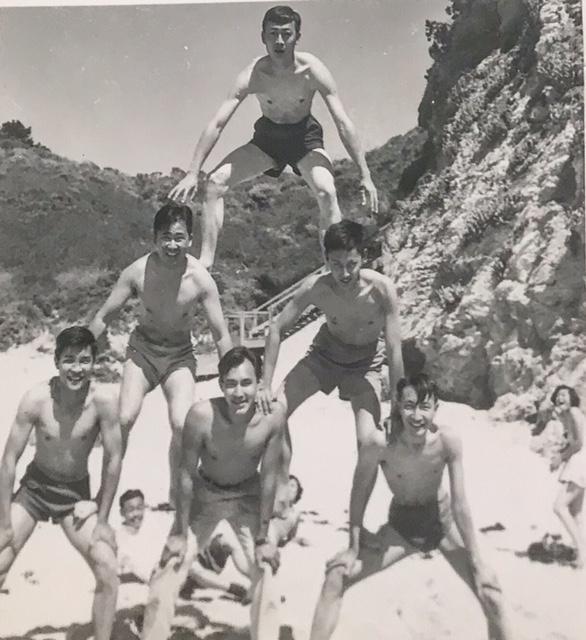
Cal Berkeley Crowd, all Shang…
1953, Stinson Beach, CA
Cal Berkeley Crowd, all Shanghai lads except Cary Mak. Botton row l-r: Cary Mak, Ed Young, George Ling (cousin). Middle row, left: Pascal Yuen. Top: Robert Chen, music major, afraid of heights! In 1957 Ed would be best man at George’s wedding and chaperone/driver on his honeymoon.
Comments:
  • Please make sure you've written a comment before it can be published. If you prefer to remove your comment, you can delete it.
  • Sorry, we had some trouble updating your comment.
Siblings, from left -  Ed, Fi…
1934, Tientsin, China
Siblings, from left - Ed, Fifi, Hardie, Bud, Mimi
Ed (r) and Carl (l), husband …
1954, Point Pleasant, NJ
Ed (r) and Carl (l), husband of Fifi. At the summer cottage of Alice Hing. Ed recalls teaming with Alice in a tennis game against her parents.
l.-r.: Hardie, friend, Mimi, …
1946
l.-r.: Hardie, friend, Mimi, Eddie, Buddie
Ed (4) with his older sister …
1935, Shanghai, China
Ed (4) with his older sister Mimi (10)
Visit with the Tsai’s.  Child…
1935, Nanking, China
Visit with the Tsai’s. Children, from left: Ed, Hardie, Fifi, Mimi Adults: Qua-Ling Young (father), Tang Baoyun (mother), Wilber, Uncle Tsai, Sonny

Want to see more?

Get notified when new photos, stories and other important updates are shared.
×

Stay in the loop

Ed "Eddie" Young